
Music as a field of relationships#
The Music Mandala is a public learning reference for approaching music as an organized field rather than a list of isolated facts. It begins with a simple question: how do sound, time, form, expression, practice, and cultural context work together to make music intelligible?
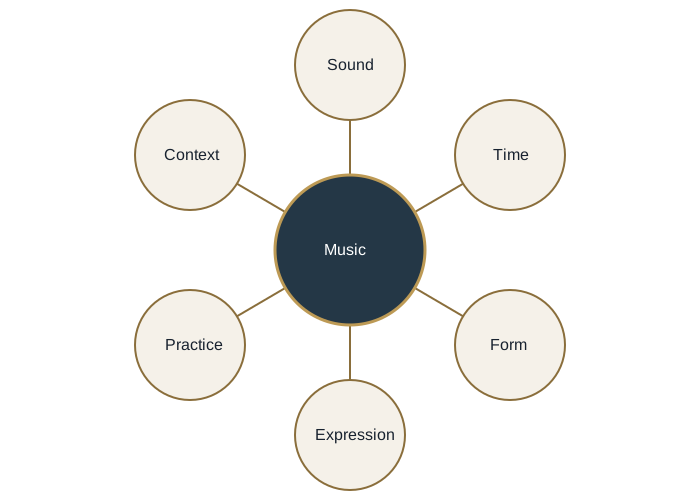
This representative map is an orientation figure, not a complete music theory, a curriculum, or a claim that every musical tradition uses the same categories.
The domain map#
At the center is music as organized sound in time. Around that center are six mutually informing areas:
- Sound: pitch, timbre, resonance, texture, and silence.
- Time: pulse, rhythm, meter, tempo, duration, and phrasing.
- Form: repetition, contrast, development, pattern, and large-scale shape.
- Expression: dynamics, articulation, gesture, mood, and interpretive choice.
- Practice: listening, technique, rehearsal, composition, improvisation, and performance.
- Context: tradition, community, instrument, venue, purpose, history, and audience.
None of these areas stands alone. Rhythm changes the character of sound; form gives expression a larger shape; practice develops attention to context; a tradition can reshape the meaning of every category on the map. The point is not to settle the field in six terms. It is to make the relationships available for learning.
How to use the map#
Choose one piece of music, performance, song, or musical question. Start at the center, then choose one outer area to notice closely. You might listen for time before trying to name harmony, or consider context before judging expression. Return to the center and ask how the chosen area changes your sense of the whole.
This approach supports beginners and experienced listeners differently. Beginners can gain a vocabulary for attention. More experienced readers can use the map to compare how different traditions organize sound, learning, and performance. It does not replace study with teachers, musicians, histories, or traditions. It gives a bounded way to begin.
Boundaries and relationships#
The Music Mandala does not claim professional instruction, therapeutic effect, cultural authority, or a universal theory of music. It does not reduce a tradition to a diagram. It is a public reference page whose job is orientation.
It belongs to the Domain Mandalas learning hub, where the open book series and learning family are explained. Its learning posture is also informed by UKM, MoM, and MLP: structure should help learners see relationships, return at greater depth, and remain aware of a domain’s boundaries.
Released book relationship#
This primer offers a representative educational entry point to the Music Mandala. The Mandala of Music develops the domain at a fuller scale as the first released book in the Domain Mandalas series. This page remains useful as an introductory map and does not replace the book.