Canonical conceptual hub

Frameworks for intelligence, cognition, and structured AI systems

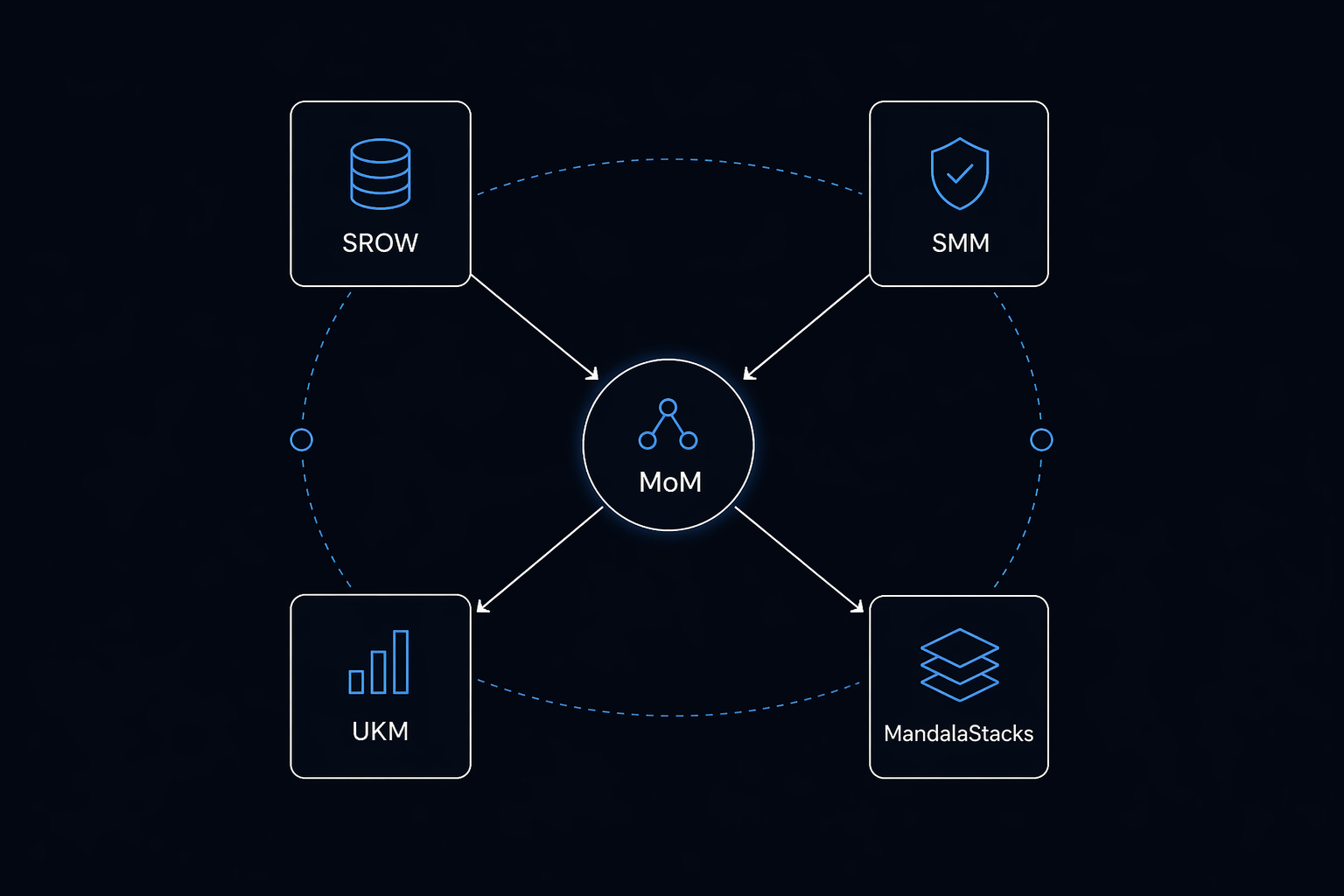
This is the canonical WinMedia layer for the frameworks themselves: what they are, why they exist, and how they relate across the ecosystem before they are turned into applied tools.

Core Frameworks

The primary architectural frameworks that define how structured intelligence is named, organized, and extended.

Core framework

SMM

SMM treats intelligence as structured depth rather than undifferentiated scale. It offers a layered frame for moving from language and reasoning toward ontology, judgment, and care.

Problem addressed

Most AI systems compress syntax, reasoning, worldview, and response posture into one opaque stream, making both interpretation and correction difficult.

Core framework

UKM

UKM addresses how knowledge should be arranged when intelligence systems need consistency across fragments, summaries, and larger conceptual maps.

Problem addressed

Knowledge systems often degrade as they expand, leaving local entries detached from the larger structure they are supposed to serve.

Core framework

MoM

MoM focuses on transition, not just storage. It clarifies how a system carries meaning forward without distorting the original structure.

Problem addressed

Systems often fail because they move between states without preserving the logic of that movement.

Core framework

Big Net

Big Net is concerned with connectedness under structure. It looks at how systems interrelate while preserving boundaries and roles.

Problem addressed

Large networks are often treated as inherently intelligent even when their internal relationships remain weakly governed.

Supporting Structures

The stabilizing structures that preserve memory, boundaries, transitions, and agency across the larger system.

Supporting structures

Supporting Structures

Supporting Structures names the disciplined layer beneath the named frameworks. These are the stabilizers that keep a system coherent while it operates.

Problem addressed

Primary frameworks often receive the attention while the enabling structures that preserve coherence are treated as implementation details.

Expression & Method

Methods for how structured intelligence is expressed, interpreted, and carried forward in use.

Expression and method

SROW

SROW belongs to the expression layer of the ecosystem. It is concerned with how writing carries structure clearly enough to survive real reading conditions without collapsing into simplification.

Problem addressed

Important writing often fails not because the ideas are weak, but because the structure is too buried for readers to recover under speed, scale, and attention pressure.

Expression and method

cog

cog is where cognition is treated as an architectural concern rather than a loose metaphor. It explores how a system forms stance, continuity, and interpretive discipline.

Problem addressed

Many systems simulate cognition rhetorically without a real structure for memory, transition, and self-positioning.

SMM reading path

Move from the SMM framework to the draft and contact surface

The Sanskrit Mandala Model now has a clearer continuity path across framework, draft, and outreach.

Applied bridge

Apply the frameworks in MandalaStacks

Framework pages on WinMedia explain the conceptual architecture. MandalaStacks is the place to use that architecture in generators, guided systems, and interactive workflows.

Where appropriate, each framework can bridge outward to the applied layer without collapsing the distinction between canonical explanation and operational use.

Use in MandalaStacks