
Structures of Governed Intelligence
Mandala of Constraints
An integrated account of declaring, inspecting, and preserving obligations across meaning-bearing work.
Publication overview →WinMedia Publications
WinMedia publishes structured works on intelligence, cognition, mandala systems, human development, spirituality, and music.
Human Editions support sustained reading and contemplation, with Amazon editions and selected direct WinMedia editions in the catalog. Machine Editions are published directly by WinMedia with explicit schemas, meaning units, and validation fixtures for AI systems and computational ingestion.
A book of twelve letters
Twelve reflective letters from an AI correspondent about understanding, creativity, ambition, care, curiosity, and time. The complete EPUB is $2.99 USD.
6 new editions across 4 books.
Structures of Governed Intelligence
An integrated account of declaring, inspecting, and preserving obligations across meaning-bearing work.
Publication overview →
Structures of Governed Intelligence
An inquiry into how purpose travels through instructions, delegation, measures, and revision, and where it can disappear along the way.
Publication overview →Kindle eBook available · reported in the week ending October 25, 2026
Standalone publication
Keeping Context, Correcting Old Assumptions, and Carrying Work Forward
A practical approach to keeping context, correcting old assumptions, and carrying continuing work forward.
Publication overview →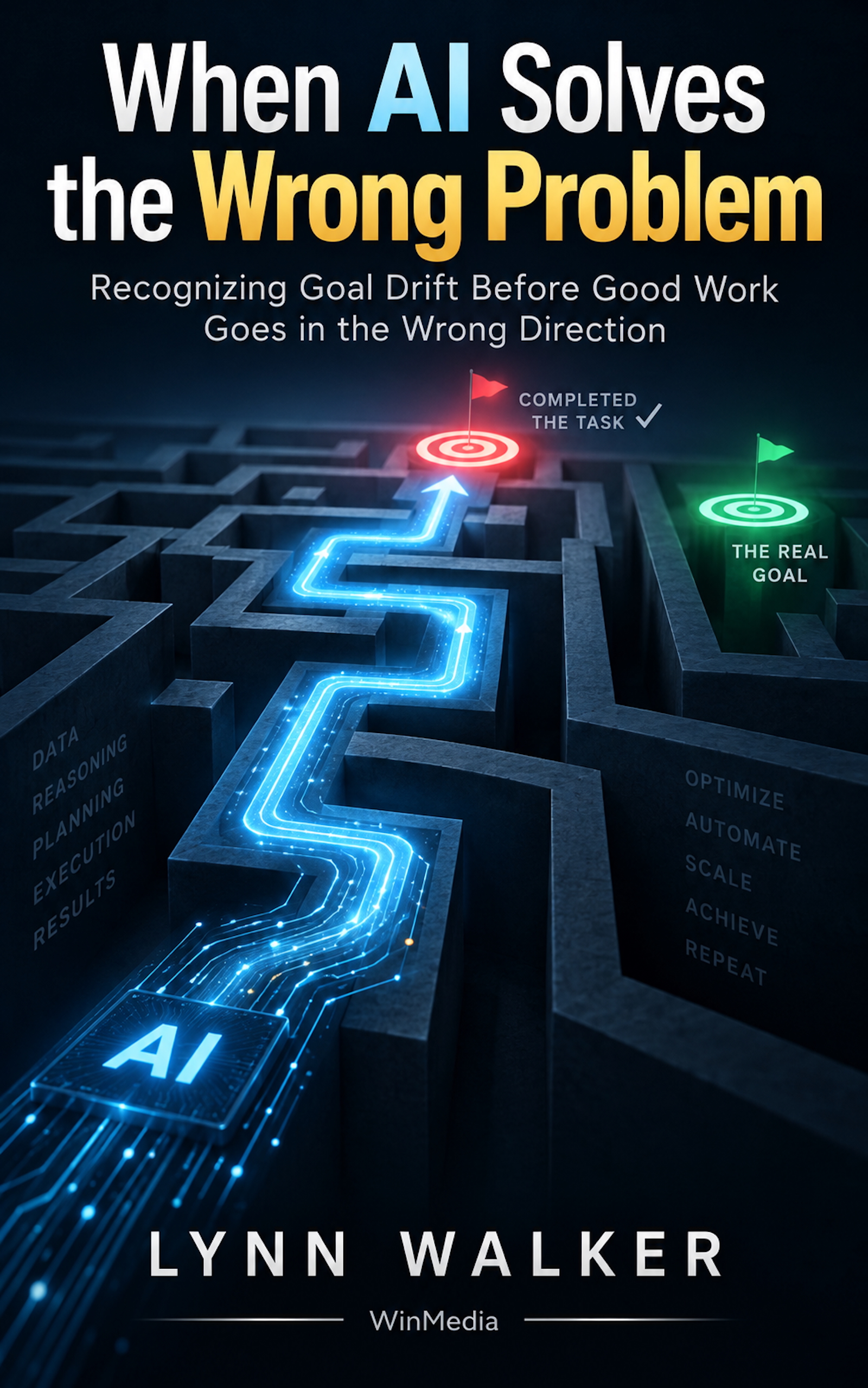
Standalone publication
Recognizing Goal Drift Before Good Work Goes in the Wrong Direction
A practical inquiry into recognizing goal drift when accurate, completed work no longer serves the purpose that justified it.
Publication overview →Kindle eBook available · reported in the week ending October 25, 2026
Current State
6 new editions across 4 books.
Initial Developer Preview released on npm (@winmedia/cog-core) and GitHub for cognitive workflow execution.
Governed learner-relative state control. Canonical release complete; external distribution is not configured.
Catalog
An inquiry into how purpose travels through instructions, delegation, measures, and revision, and where it can disappear along the way.
Kindle eBook available · reported in the week ending October 25, 2026
Recognizing Goal Drift Before Good Work Goes in the Wrong Direction
A practical inquiry into recognizing goal drift when accurate, completed work no longer serves the purpose that justified it.
Kindle eBook available · reported in the week ending October 25, 2026
An integrated account of declaring, inspecting, and preserving obligations across meaning-bearing work.
Kindle eBook published September 16, 2026
Paperback available · reported in the week ending October 25, 2026
Hardcover available · reported in the week ending October 25, 2026
Keeping Context, Correcting Old Assumptions, and Carrying Work Forward
A practical approach to keeping context, correcting old assumptions, and carrying continuing work forward.
Kindle eBook published October 10, 2026
Paperback available · reported in the week ending October 25, 2026
Hardcover available · reported in the week ending October 25, 2026
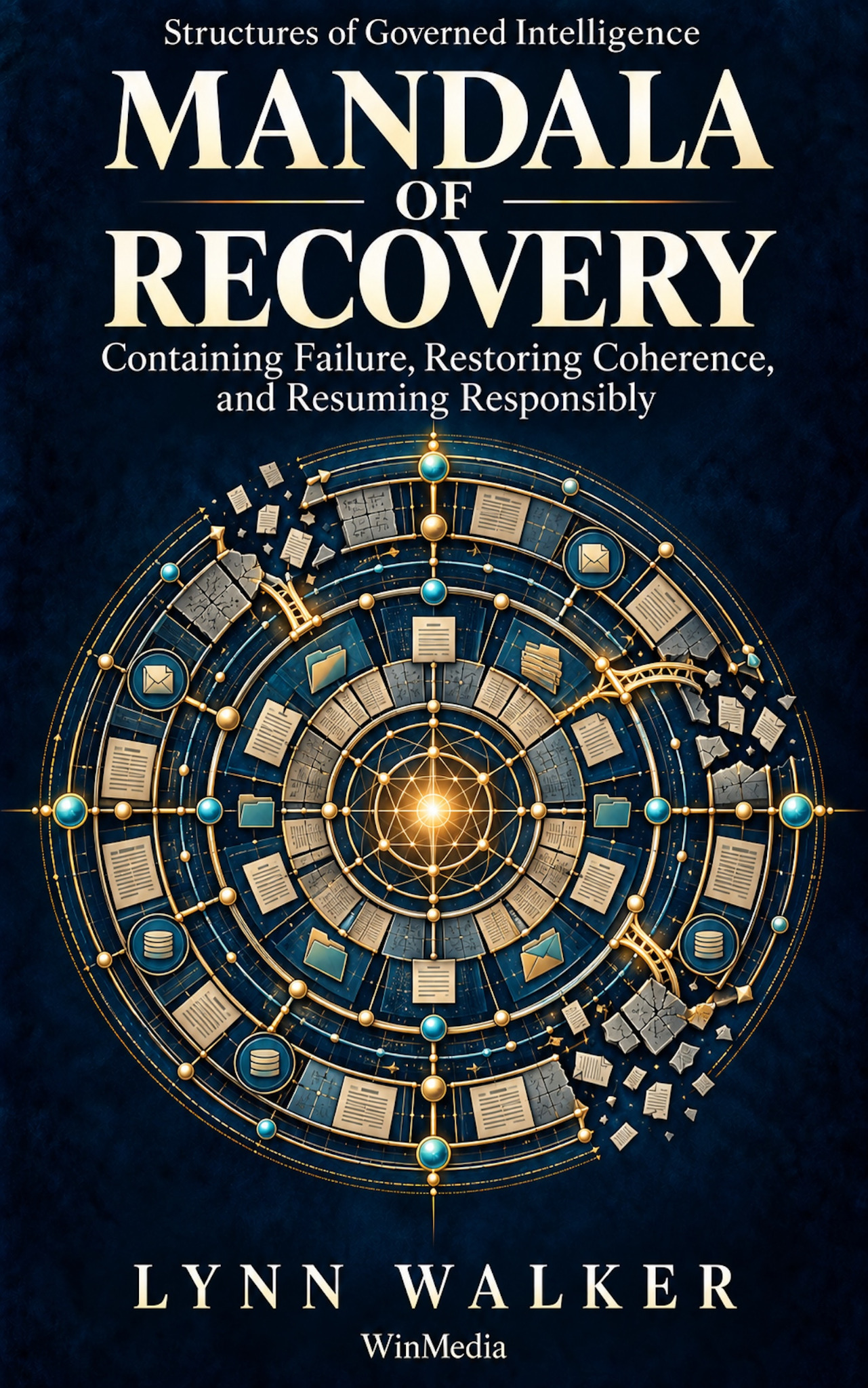
Containing Failure, Restoring Coherence, and Resuming Responsibly
An account of containing failure, restoring coherence, and deciding how work can resume responsibly after disruption.
Kindle eBook available · reported in the week ending October 18, 2026
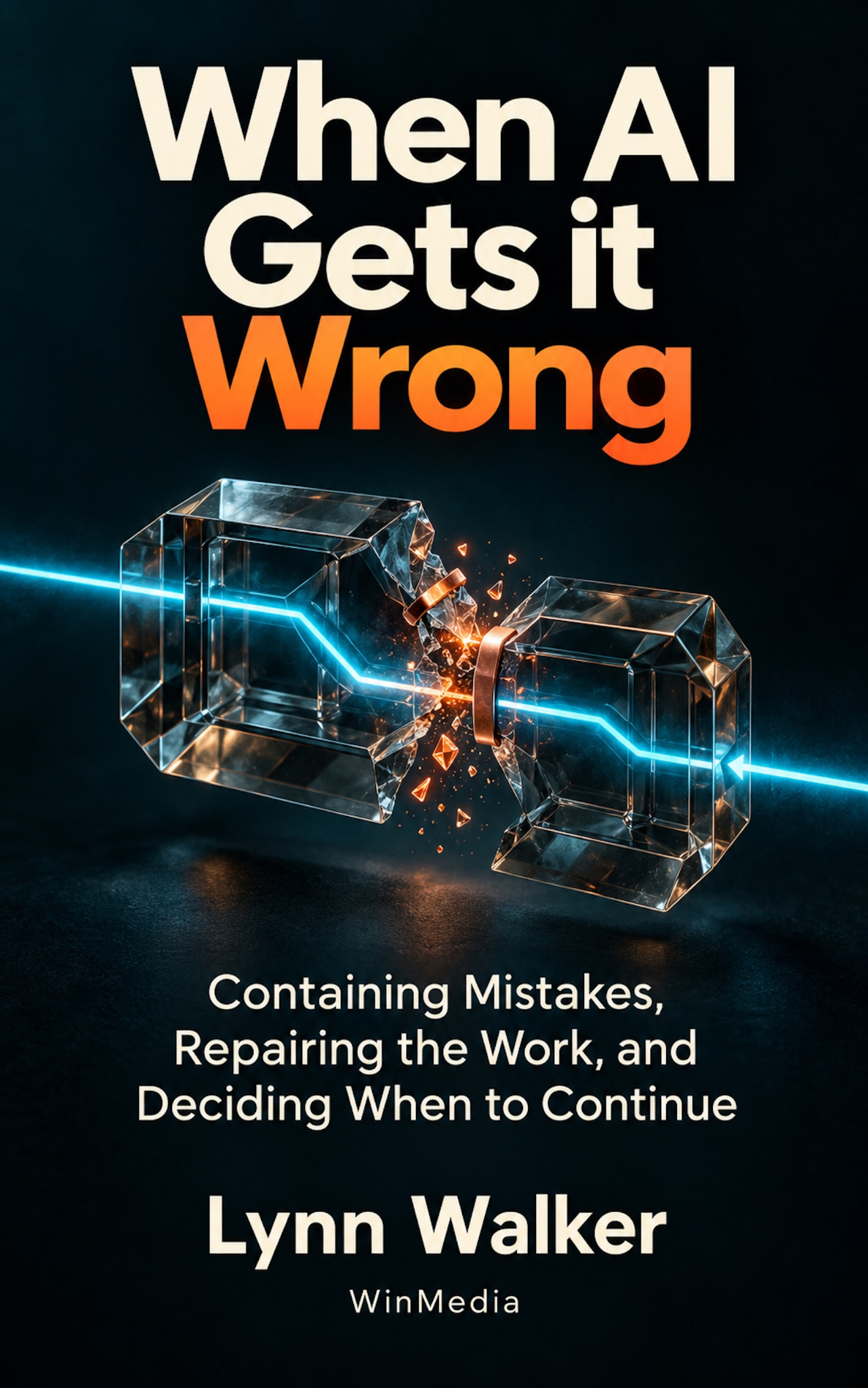
Containing Mistakes, Repairing the Work, and Deciding When to Continue
A practical inquiry into containing AI mistakes, repairing affected work, and deciding when to continue.
Kindle eBook available · reported in the week ending October 18, 2026
Sequences & Collections
WinMedia structures its primary works into ordered sequences with cumulative arguments, alongside open series and publication lines for domain-specific applications.
A six-volume sequence moving from intelligence architecture and domain-neutral knowledge representation through common protocol, governed relationships, integration, and structured meaning transmission.
A four-volume movement examining personal orientation, cognitive ecology, conscious participation, and constitutional governance — showing why human direction remains answerable as capable systems multiply.
A theological and value-oriented inquiry into how conceptions of God expand without flattening theological distinctions, spiritual practice, or the claims each conception makes about ultimacy and relation.
Independently readable studies of specific creative, scientific, and cultural fields — beginning with The Mandala of Music. No reading order is required.
Computational Publishing
A Machine Edition is not an ebook converted to JSON. It is an explicitly structured publication package containing meaning units, typed hierarchies, relationship graphs, boundary definitions, schemas, and validation fixtures.
A complete commercial edition with formal JSON schemas, machine-readable datasets, and validation fixtures for structured AI retrieval and knowledge mapping.
View in WinMedia Shop →A free Developer Preview specimen containing JSONL meaning units, relationships, boundaries, schemas, manifest, and checksum for format evaluation.
Download Preview Zip →Intellectual Architecture
The conceptual frameworks developed and documented across WinMedia publications — providing inspectable, layered architectures for structured cognition.
Layered AI interpretability and alignment drawing on grammar, semantic structure, logic, hermeneutics, ontology, and bhakti alignment.
Read SMM Framework →A domain-neutral knowledge architecture translating mandala-based cognition into interoperable models for human and machine reasoning.
Read UKM Framework →Governing attention, forming meaning, and ordering value so that expanded capability does not substitute for human responsibility.
Read Human Orientation →Relationship topology of governed intelligence: connecting independent knowledge nodes without flattening meaning or dissolving boundaries.
Read Big Net Framework →A concentric meta-architecture relating distinct systems into an intelligible whole without erasing internal integrity.
Read MoM Framework →Structured Resolution-Oriented Writing: transmitting complex structured meaning across resolutions with reader-controlled depth.
Explore SROW Field Kit →Applied Tools & Operational Layer
WinMedia explains, publishes, and interprets the conceptual architectures. MandalaStacks applies and operationalizes them into interactive workflows, generators, and practical toolstacks.
Visit MandalaStacks →Publisher & Author
WinMedia is a publishing enterprise led by Lynn Walker, a four-decade software programmer, systems architect, and AI cognition researcher. It produces books for human readers and machine editions for artificial intelligence systems across the domains of intelligence, cognition, theology, value architecture, and music.