
What is MLP#
Mandala Learning Protocol, or MLP, is the canonical WinMedia framework for learning progression. It describes how structured knowledge becomes internalized, retained, embodied, and eventually usable in practice through deliberate recurrence rather than one-pass exposure.
On WinMedia, MLP is presented as a framework rather than as a study tip or a training exercise. Its role is to define the shape of the learning loop that sits downstream from clear presentation: once knowledge has been structured well, MLP governs how it is absorbed and carried forward.
Why it exists#
MLP fills the gap between readable structure and durable capability. SROW clarifies how knowledge is presented and navigated. MLP clarifies how that knowledge is taken in, stabilized, and returned to as a living practice.
Without a learning protocol, structured material can stay legible while never becoming embodied. The result is comprehension without retention, or exposure without transfer. MLP exists to prevent that gap from becoming the default condition.
The core loop#
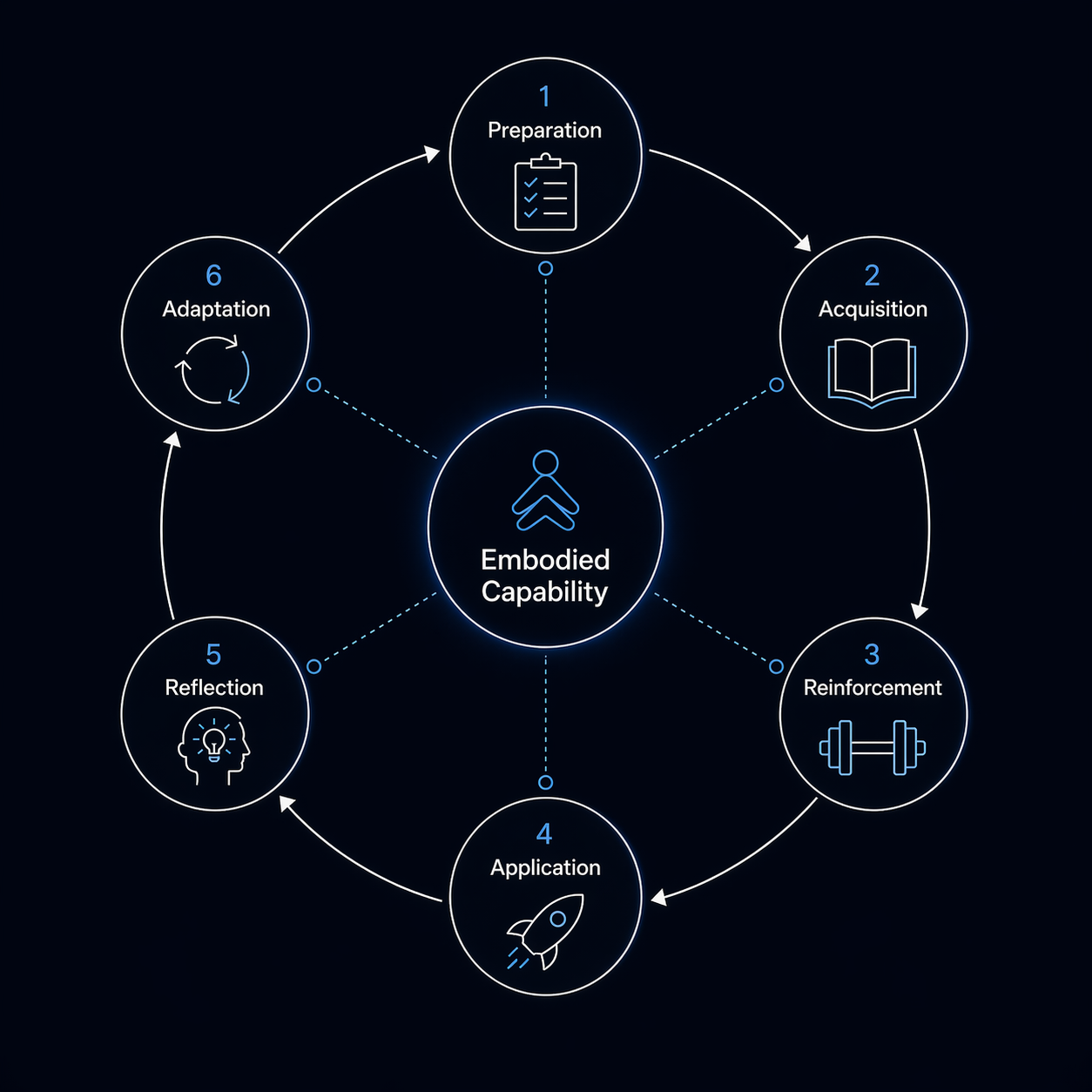
MLP is cyclical rather than linear. Each pass through the loop strengthens the next pass.
- Preparation - orient attention, set the frame, and prime the learner for the work ahead.
- Acquisition - receive the material and take in the structure that has been presented.
- Reinforcement - repeat, restate, compare, and stabilize what needs to remain present.
- Application - use the knowledge in action so it can prove itself beyond recognition.
- Reflection - review what held, what shifted, and what still needs clarification.
- Adaptation - revise the approach and return to preparation with a stronger loop.
What it enables#
MLP supports several outcomes that matter for canonical knowledge work:
- retention across time instead of temporary exposure
- stronger transfer from one context to another
- more reliable embodiment of structured knowledge
- repeatable practice without flattening the original framework
- learning that improves with recurrence rather than degrading into rote repetition
These outcomes matter because knowledge only becomes operationally valuable when it can survive movement through time, context, and use.
Relationship to the ecosystem#
MLP sits in a deliberate relation to the other WinMedia frameworks.
SROW#
SROW governs presentation and navigability. MLP governs learning progression and internalization. SROW helps the reader enter the structure; MLP helps the structure become retained and usable.
UKM#
UKM defines knowledge structure. MLP operates within that structure as the recurring process by which knowledge is absorbed, reinforced, and applied.
MoM#
MoM places MLP in a larger system-of-systems order. That keeps learning protocol distinct from the higher-level relationships among frameworks and prevents it from being treated as a substitute for meta-architecture.
MandalaStacks#
MandalaStacks is the downstream applied layer where MLP may eventually inform guided learning surfaces, repeated workflows, or practical systems of use. That relation is real, but it remains secondary to the canonical definition on WinMedia.
Canonical vs applied#
WinMedia explains MLP as a stable framework. MandalaStacks can apply it later when the learning loop needs a practical surface.
Where it leads#
MLP leads toward more durable study, more stable repetition, and more transferable use of structured knowledge. It keeps learning from stopping at recognition and pushes it toward embodied capability.
In the wider ecosystem, that means MLP remains aligned with SROW for readable presentation, with UKM for structural knowledge, and with MoM for higher-order relation. The page here defines the protocol; later surfaces can use it without changing what it means.
Related reading#
For structured presentation and navigation, see SROW. For knowledge structure, see UKM. For system-of-systems relation, see MoM. For the supporting context that keeps learning stable, see Supporting Structures.