
What is MoM#
MoM, or Mandala of Mandalas, is a meta-architecture for understanding how coherent systems relate to one another without losing their boundaries, roles, or internal integrity.
On WinMedia, MoM is presented as the canonical framework for system-of-systems order. Its concern is not how one system thinks internally or how one page is written, but how multiple mandalas remain composable within a larger structure.
The problem it solves#
MoM addresses a higher-order failure: systems may be internally coherent and still become unstable when they are related without clear meta-structure.
That failure appears when boundaries blur, roles overlap, one system silently replaces another, or multiple frameworks are connected without an explicit account of containment, adjacency, or coordination. The result is fragmentation at the ecosystem level rather than within a single framework.
MoM addresses that problem by making system-of-systems relationships explicit.
Core structural model#
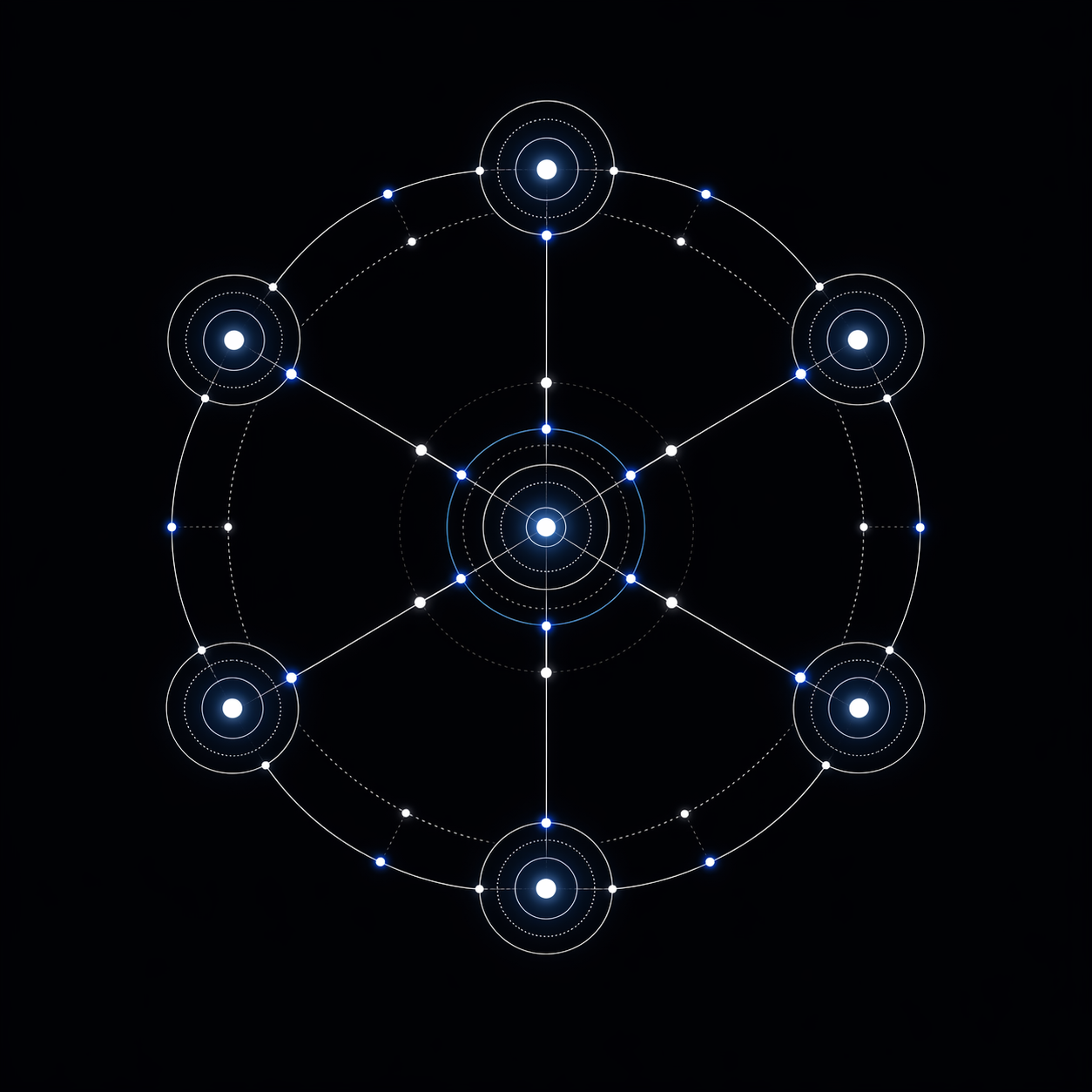
MoM treats mandalas as coherent systems and then defines how those systems may relate within a larger order.
Mandalas as systems#
A mandala is treated as a bounded system with its own internal structure, role, and coherence conditions. It is not a loose bundle of concepts. It is a system that must remain intelligible in itself before it can be meaningfully related to others.
System-of-systems relationships#
MoM defines how systems relate through explicit higher-order relationships such as parent-child containment, peer adjacency, nested composition, and coordination across boundaries.
These relationships matter because systems should not be connected by implication alone. If relation exists, it should be named.
Composability#
MoM requires that systems be composable without being collapsed into sameness. Composition should preserve identity, role, and legibility rather than dissolving smaller systems into a vague larger whole.
Containment#
Containment clarifies how one mandala may sit within another without becoming identical to it. It preserves layered relation between local system and larger order rather than flattening them into one undifferentiated structure.
Relationship to other frameworks#
MoM belongs to the architectural layer that governs how systems relate, so its distinctions from adjacent frameworks must remain clear.
UKM#
UKM defines cognition structure within a knowledge system. MoM defines how systems that may include UKM-shaped architectures relate at a higher level. UKM is internal architecture; MoM is meta-architecture.
SROW#
SROW defines how structured knowledge is expressed. MoM defines how systems relate. SROW can communicate MoM clearly, but it does not replace MoM's role as a system-of-systems framework.
Why MoM matters#
MoM matters because large ecosystems fail when system relationships are left implicit. A framework may be clear locally and still contribute to confusion globally if its role, boundaries, or position within a larger order remain undefined.
MoM provides a disciplined answer to that problem. It preserves coherence above the level of any single system by naming how systems compose, contain, coordinate, and remain distinct.
Practical implications#
Once MoM is understood, several practical implications follow.
Framework builders can ask not only whether a system is internally coherent, but how it sits within a larger environment. Editors can clarify when a framework is primary, nested, adjacent, or downstream rather than allowing those relations to drift. Applied systems can inherit a cleaner account of boundaries and composition before operationalization begins.
Where it leads#
MoM leads toward a more coherent ecosystem architecture. It creates the conditions for multiple frameworks, protocols, and systems to remain related without becoming confused or interchangeable.
For WinMedia, that makes MoM the canonical overview of how systems relate at the highest level. It does not replace cognition structure or communication structure. It governs the order within which those structures can coexist coherently.
Related reading#
For cognition structure, see UKM. For expression protocol, see SROW. For the broader architectural publication context, see The Sanskrit Mandala Model.