
Direct Answer#
Decision Mandala (DM v0.1) is a structured framework for transforming knowledge, constraints, and context into coherent, defensible action.
It defines:
- what a decision consists of
- how it is formed
- how it is refined
- how it remains coherent under complexity
Why It Exists#
WinMedia already defines systems for presentation, structure, generalization, system relation, and embodiment.
DM fills the missing layer:
Without DM, a system may explain, organize, and teach, but not resolve.
Core Insight#
A decision is not merely a choice.
It is the resolution of constraints, context, and intention into a coherent action path.
The Structure of a Decision#
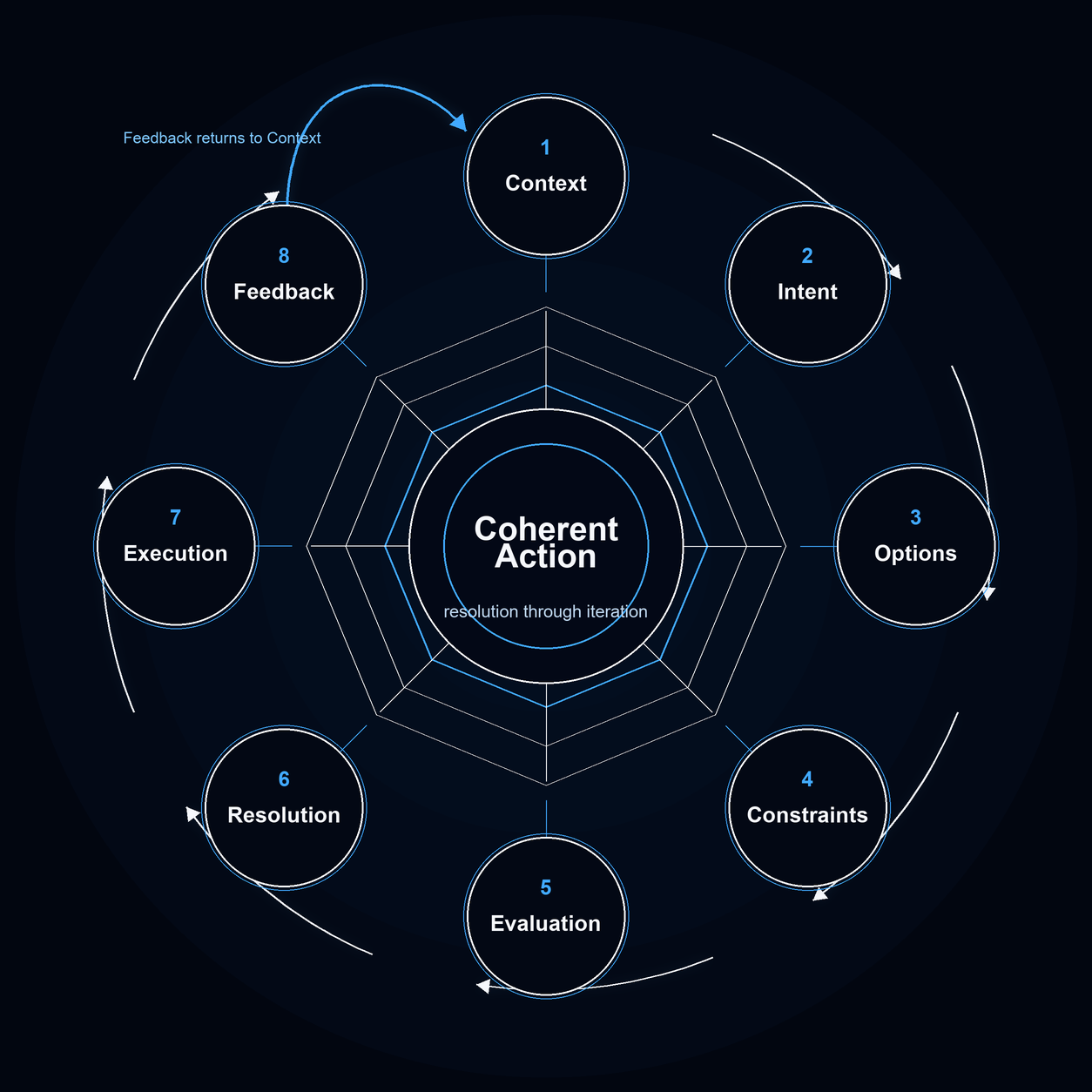
DM uses a hybrid model: a layered structure plus an iterative loop.
Layer 1 - Context#
What situation are we in?
- environment
- constraints
- known variables
- unknowns
Without context, decisions remain abstract.
Layer 2 - Intent#
What are we trying to achieve?
- goals
- priorities
- success criteria
Intent anchors direction.
Layer 3 - Options#
What paths are available?
- candidate actions
- alternative strategies
- potential approaches
Options define the decision space.
Layer 4 - Constraints#
What limits or shapes the options?
- resources
- time
- tradeoffs
- dependencies
Constraints remove illusion from decision-making.
Layer 5 - Evaluation#
How do the options compare?
- coherence
- feasibility
- alignment with intent
- risk profile
This is where decisions gain rigor.
Layer 6 - Resolution#
What is the selected path?
- chosen action
- justification
- expected outcome
Resolution is the decision itself.
Layer 7 - Execution#
What actually happens?
- implementation
- real-world action
- monitoring
A decision not executed is not yet complete.
Layer 8 - Feedback#
What happened as a result?
- outcomes
- deviations
- unexpected effects
Feedback closes the loop.
The Decision Loop#
Decisions are not one-time events.
They operate as a loop:
Context -> Intent -> Options -> Constraints -> Evaluation -> Resolution -> Execution -> Feedback -> Context
Each cycle:
- refines understanding
- updates context
- improves future decisions
Decisions converge through iteration, not perfection.
What DM Enables#
Coherent Decision-Making#
Instead of ad hoc reasoning, DM provides structure, clarity, and traceability.
Complex Problem Handling#
DM works when variables are incomplete, constraints conflict, and outcomes are uncertain.
Alignment Across Systems#
DM connects structured knowledge, generalized understanding, and learned capability into action.
Explainable Decisions#
A DM-based decision can answer:
- why this option?
- what constraints mattered?
- what tradeoffs were made?
Relationship to the Ecosystem#
DM and SROW#
SROW makes decision reasoning readable and navigable.
DM and SMM#
SMM supplies structured meaning that DM can resolve into action.
DM and UKM#
UKM allows DM to apply across domains without relying on a single ontology.
DM and MLP#
MLP develops the capability to use structured knowledge. DM gives that capability a decision target.
DM and MoM#
MoM places DM within the larger system-of-systems as the resolution layer.
Canonical vs Applied#
This page defines DM canonically.
It explains what a decision is structurally and how decision reasoning is organized.
It does not define:
- UI flows
- user decision tools
- decision generators
- automated outputs
Those belong in MandalaStacks later.
Conceptual Example#
Instead of saying:
DM would represent the decision as:
- Context: early-stage system, still unstable
- Intent: sustainable growth
- Options: scale now, stabilize first, or reduce scope
- Constraints: architecture incomplete, validation incomplete
- Evaluation: scaling now increases fragility
- Resolution: stabilize structure before scale
- Execution: refactor and validate the system
- Feedback: observe whether the system becomes more robust
Where DM Leads#
DM is the bridge between knowledge and action.
- SROW makes knowledge readable
- SMM makes knowledge structured
- UKM makes knowledge transferable
- MLP makes knowledge embodied
- DM makes knowledge decisive
This page defines the framework. Future applied decision surfaces belong on MandalaStacks.