
Direct Answer#
Transformation Mandala (TM v0.1) is a structured framework for modeling how systems move from one state to another through constrained transitions.
It defines:
- what a transformation is
- how state changes occur
- what governs transitions
- how transformations succeed or fail
Why It Exists#
WinMedia now defines systems for presentation, structure, generalization, system relation, embodiment, and decision.
TM fills the missing layer:
Without TM, a system can decide what should happen, but it cannot formally model how reality changes when action begins.
Core Insight#
A transformation is not merely an action.
It is the structured movement from one state to another under constraints, dynamics, and feedback.
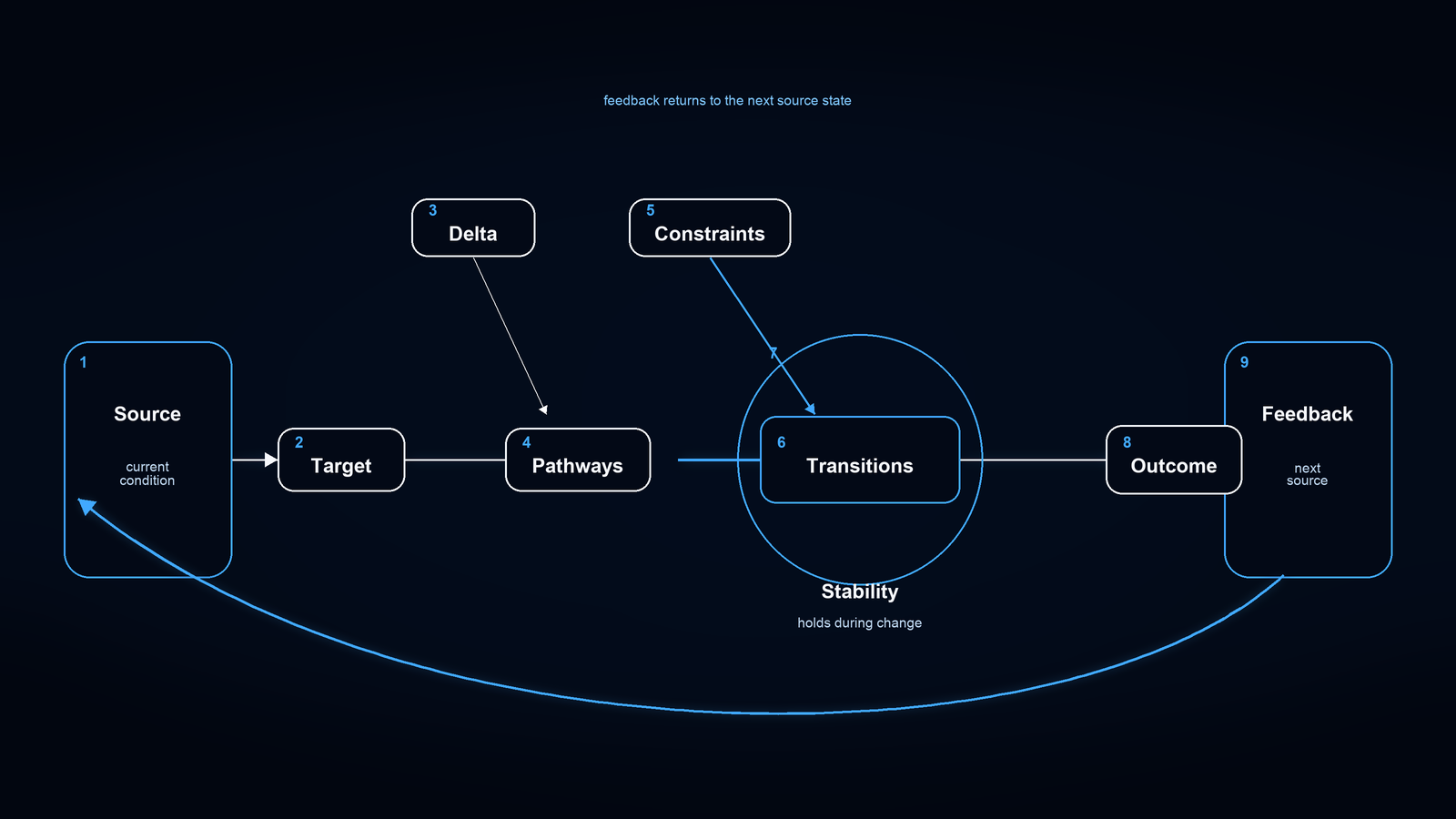
The Structure of Transformation#
TM defines transformation as a state-transition system with constraints and feedback.
Layer 1 - Source State#
Where are we starting?
- current system condition
- existing structure
- stability level
- limitations
Without a clear source state, transformation is undefined.
Layer 2 - Target State#
Where are we going?
- desired outcome
- future structure
- success definition
Without a target, transformation has no direction.
Layer 3 - Delta#
What separates source from target?
- structural differences
- capability gaps
- missing components
- unresolved constraints
This is the transformation distance.
Layer 4 - Pathways#
What routes can connect source to target?
- strategies
- sequences
- alternative approaches
- staged options
Multiple pathways may exist.
Layer 5 - Constraints#
What limits or shapes transformation?
- resources
- time
- dependencies
- external pressures
- risk boundaries
Constraints determine feasibility.
Layer 6 - Transitions#
What actual changes occur?
- stepwise state changes
- intermediate states
- dependency shifts
- structural reconfiguration
This is where transformation becomes real.
Layer 7 - Stability#
Does the system hold together during change?
- resilience
- failure modes
- load-bearing structures
- continuity risks
Transformation without stability leads to collapse.
Layer 8 - Outcome#
What resulted?
- achieved state
- partial success
- failure
- unintended effects
The outcome may or may not match the target.
Layer 9 - Feedback#
What did the transformation reveal?
- unexpected effects
- deviations
- new constraints
- updated understanding
Feedback becomes part of the next source state.
The Transformation Loop#
Transformations are iterative:
Source -> Target -> Delta -> Pathways -> Constraints -> Transitions -> Stability -> Outcome -> Feedback -> Source
Each cycle:
- reveals new information
- updates constraints
- refines future transformations
Transformation is continuous reconfiguration, not a single jump.
What TM Enables#
Explicit Change Modeling#
Instead of vague statements like "improve the system," TM forces a defined start, defined end, and defined path.
Complex System Evolution#
TM supports multi-step change, unstable systems, conflicting constraints, and partial outcomes.
Alignment With Decision#
DM selects what should be done.
TM defines how the system changes when the decision is executed.
Failure Analysis#
TM makes it easier to see where transformation broke, why transitions failed, and where stability was lost.
Relationship to the Ecosystem#
TM and DM#
DM resolves decisions.
TM models the transformation created by acting on those decisions.
TM and SMM#
SMM defines structured meaning.
TM defines how structure changes over time.
TM and UKM#
UKM generalizes knowledge across domains.
TM generalizes transformation across domains.
TM and MLP#
MLP builds capability through learning.
TM models how that capability changes systems.
TM and MoM#
MoM connects frameworks into a system-of-systems.
TM explains how systems evolve within that larger network.
Canonical vs Applied#
This page defines TM canonically.
It explains what transformation is structurally and how state change can be understood.
It does not define:
- workflows
- automation
- transformation generators
- execution engines
Those belong in MandalaStacks later.
Conceptual Example#
Instead of saying:
TM would represent the transformation as:
- Source: unstable early system
- Target: scalable and stable system
- Delta: missing architecture and validation
- Pathways: refactor, rebuild, or reduce scope
- Constraints: time, resources, continuity requirements
- Transitions: module-by-module redesign
- Stability: risk of downtime or regression
- Outcome: partially stabilized system
- Feedback: architecture still needs reinforcement
Where TM Leads#
TM is the bridge between decision and real change.
- SROW makes knowledge readable
- SMM makes knowledge structured
- UKM makes knowledge transferable
- MLP makes knowledge embodied
- DM makes knowledge decisive
- TM makes knowledge transformative
This page defines the framework. Future applied transformation surfaces belong on MandalaStacks.