Publication series

Human and Participatory Intelligence

A four-book movement from person to field, participation, and legitimate order.

Status
Complete — Four Volumes
Volumes
4 of 4 volumes released

Series question: How can human agency remain oriented, responsible, and legitimate as capable systems reshape the conditions of thought and action?

Series thesis: Capability does not produce legitimate direction. Human intelligence remains answerable for how attention, meaning, value, participation, and authority are formed and governed.

Why this series exists

A problem of structure and direction

AI expands capability while cognitive overload, institutional influence, and uneven power can weaken attention, judgment, consent, and responsibility. Personal intention alone cannot answer conditions that are also environmental and constitutional.

More capable systems make delegation easier at precisely the moment when the grounds for direction, review, and legitimate authority need to be more explicit.

The series offers a vocabulary for retaining responsibility without denying interdependence, technical capability, or the need for shared governance.

Series map

Person → Field → Participation → Constitution · Orient → Situate → Participate → Constitute and govern

The progression names causal transitions, not only reading order.

  1. 1. Person · Attention, meaning, and value

    Human Orientation

    Establishes the practices by which a person notices what is governing attention and judgment.

    Therefore: Orientation is necessary but insufficient because persons always think and act inside shaped environments.

  2. 2. Field · Institutional, technical, and environmental conditions

    Cognitive Ecology

    Situates cognition in the fields that distribute attention, information, incentives, and influence.

    Therefore: Seeing the field makes participation—not private intention alone—the next question.

  3. 3. Participation · Agency, consent, consequence, and repair

    Architecture of Conscious Participation

    Defines participation as accountable involvement under conditions of asymmetry and feedback.

    Therefore: Participation across institutions requires durable limits, rights, authority, and review.

  4. 4. Constitution · Legitimacy, stewardship, and governance

    Cognitive Constitution

    Addresses the constitutional conditions under which cognitive authority may be exercised, contested, and corrected.

Series primer

Load-bearing concepts

These definitions orient the reader; the books retain their sustained arguments, evidence, qualifications, and complete cases.

Orientation

The ongoing work of locating attention, interpretation, and action in relation to what matters.

Why it matters: It prevents capability from being mistaken for direction.

Developed in: Human Orientation

Not the same as: Orientation is not a preference profile or a productivity technique.

Bounded example: Before delegating a consequential task, a reader names the judgment that cannot be delegated.

Governing attention

Making the forces that direct notice and priority available for examination.

Why it matters: Attention is a precondition of judgment and cannot be treated as neutral background.

Developed in: Human Orientation; Cognitive Ecology

Not the same as: It differs from concentration by asking who or what sets the terms of focus.

Bounded example: A team audits which alerts repeatedly displace considered review.

Meaning formation

The movement from signals and context through interpretation into answerable understanding.

Why it matters: It preserves the difference between generated output and understood meaning.

Developed in: Human Orientation

Not the same as: Meaning formation is not the same as information retrieval.

Bounded example: A recommendation becomes meaningful only when its context and implications are interpreted.

Value architecture

The arrangement of commitments that actually governs choices, tradeoffs, and priorities.

Why it matters: It makes implicit ordering visible for judgment and correction.

Developed in: Human Orientation; Cognitive Constitution

Not the same as: It differs from a list of stated values by examining operative choices.

Bounded example: Speed is reconsidered when it consistently overrides care in review decisions.

Cognitive field

The social, institutional, technical, and environmental conditions that shape how thought becomes possible and likely.

Why it matters: It shows why responsibility is never merely individual.

Developed in: Cognitive Ecology

Not the same as: A field is more than a communications channel; it includes incentives and asymmetries.

Bounded example: A workplace metric can privilege visible output over careful dissent.

Conscious participation

Accountable involvement that attends to agency, consent, consequence, feedback, correction, and repair.

Why it matters: It provides a form of participation that does not dissolve responsibility into systems.

Developed in: Architecture of Conscious Participation

Not the same as: It is not passive compliance or unrestricted individual choice.

Bounded example: A participant can contest a decision process and request a reviewable rationale.

Constitutional governance

The ordering of permissions, rights, authority, limits, review, and stewardship that makes power answerable.

Why it matters: It identifies the safeguards participation needs at scale.

Developed in: Cognitive Constitution

Not the same as: It differs from administration by asking whether authority is legitimate and corrigible.

Bounded example: A consequential system includes clear appeal, review, and correction paths.

Cumulative argument

Why each volume creates the need for the next

  1. Human Orientation establishes that attention, meaning, and value must remain governed by human judgment; greater capability cannot supply this orientation.

  2. Cognitive Ecology becomes necessary because oriented persons remain embedded in fields that shape perception, incentives, and available choices.

  3. Architecture of Conscious Participation follows because field awareness creates responsibilities of consent, consequence, feedback, correction, and repair.

  4. Cognitive Constitution completes the movement by asking how authority and participation can remain legitimate under shared and asymmetric conditions.

Book spotlights

Distinct volumes, cumulative architecture

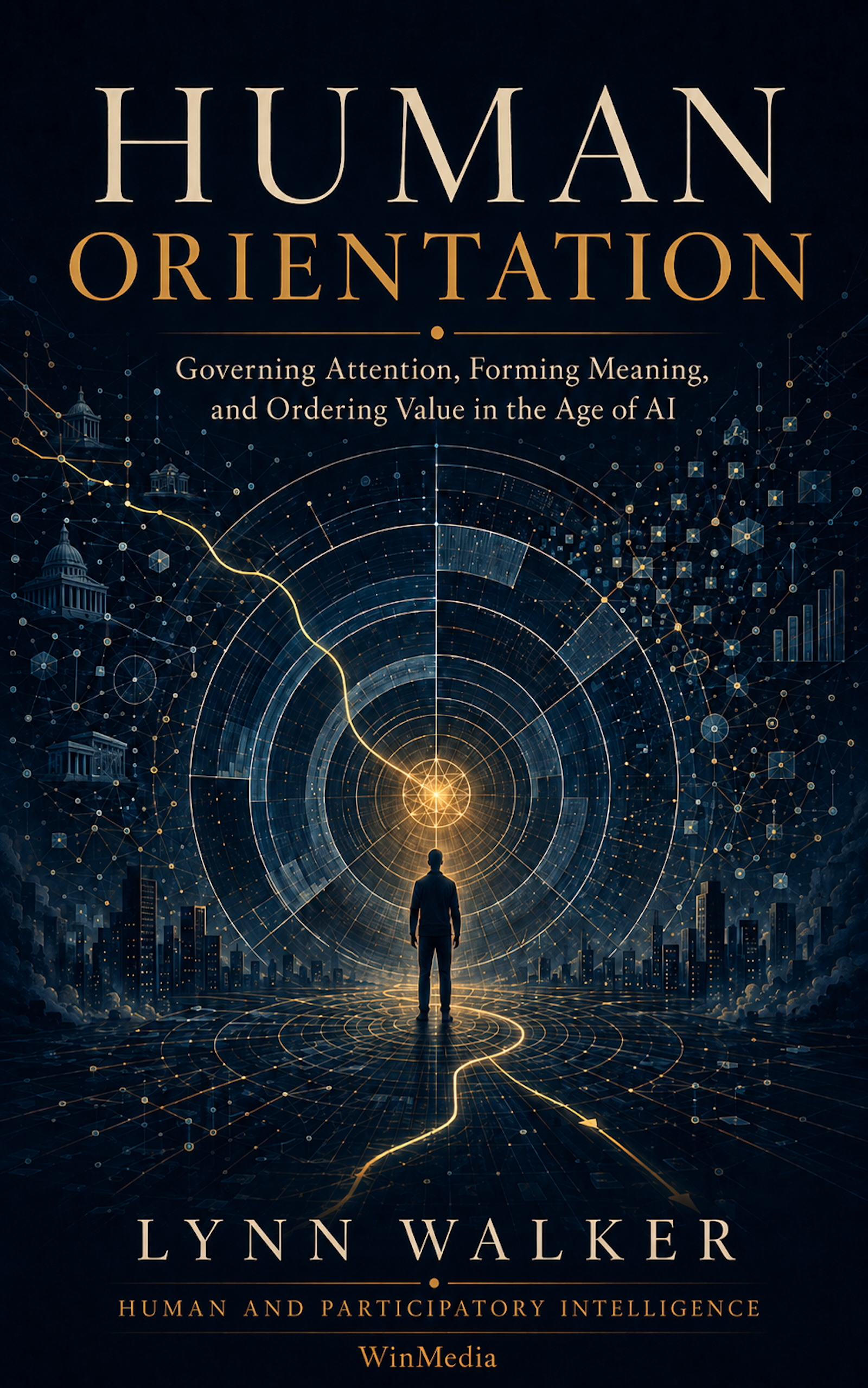
Cover of Human Orientation by Lynn Walker, a book about attention, meaning, value, and human responsibility in the age of AI

Book 1 of 4 · Available on Amazon

Human Orientation

Governing question: What must remain humanly governed when information and machine capability multiply?

It establishes orientation as a practice of governing attention, forming meaning, and ordering value before action or delegation.

  • Distinguish capability from direction.
  • Examine attention, meaning, and value as connected conditions of judgment.
  • Retain responsibility when using AI-assisted systems.

In the series: Provides the personal ground from which the rest of HPI proceeds.

Cover of Cognitive Ecology by Lynn Walker

Book 2 of 4 · Available on Amazon

Cognitive Ecology

Governing question: How do cognitive environments shape the judgment and agency of persons and institutions?

Its jurisdiction is the field: the conditions that distribute attention, influence, incentives, and interpretive possibility.

  • Recognize cognition as environmentally situated.
  • Identify institutional and technical influences on judgment.
  • Relate personal orientation to shared conditions.

In the series: Expands the series from person to the field in which persons act.

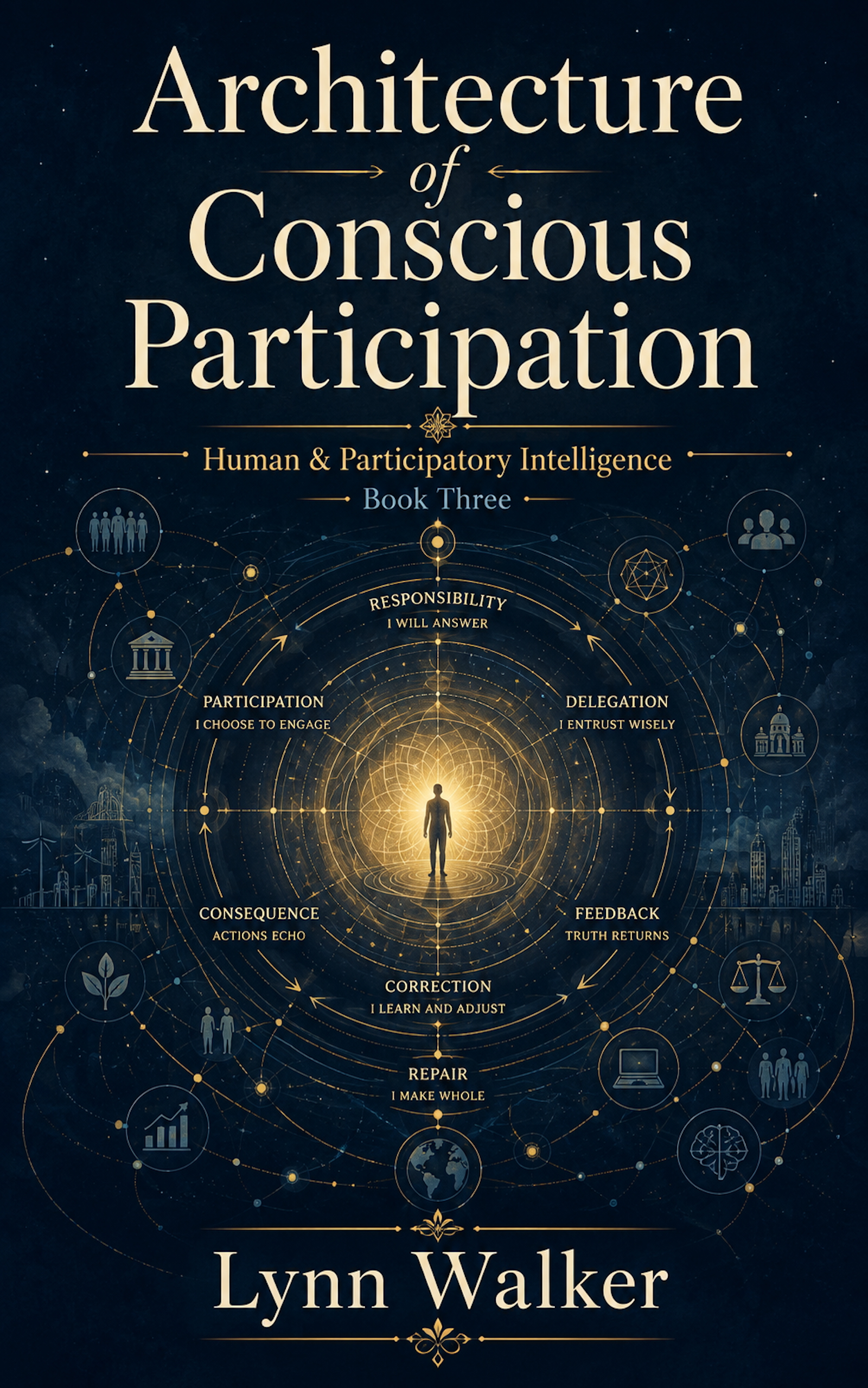
Cover of Architecture of Conscious Participation by Lynn Walker

Book 3 of 4 · Available on Amazon

Architecture of Conscious Participation

Governing question: What makes participation aware, consentful, responsible, and reparable?

Its jurisdiction is participation under asymmetry, including agency, consequence, feedback, correction, and repair.

  • Distinguish participation from passive inclusion.
  • Locate consent and responsibility inside consequential processes.
  • Treat feedback and repair as part of participation.

In the series: Turns field awareness into accountable participation.

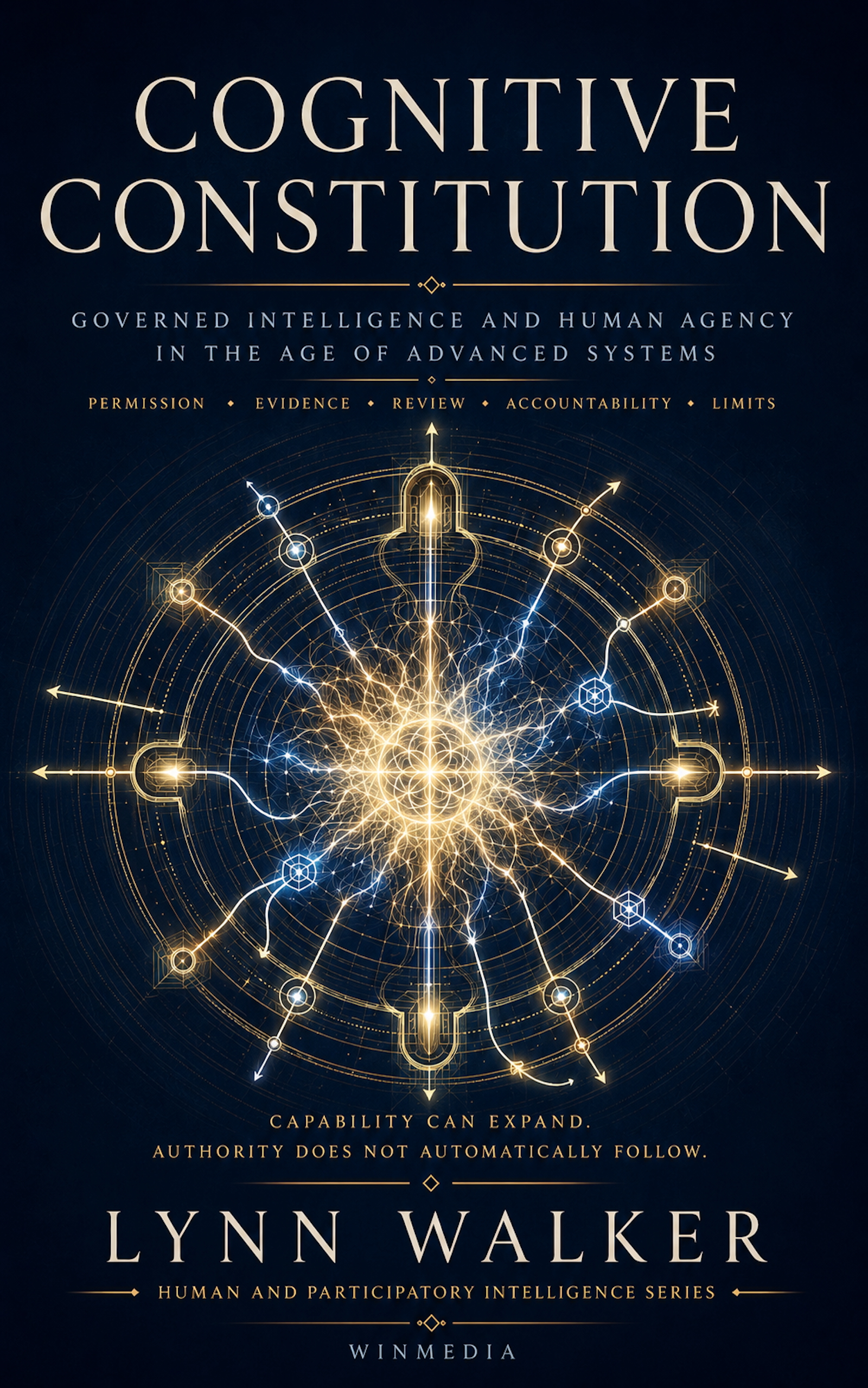
Cover of Cognitive Constitution by Lynn Walker

Book 4 of 4 · Available on Amazon

Cognitive Constitution

Governing question: What makes cognitive authority legitimate, bounded, reviewable, and stewarded?

Its jurisdiction is constitutional governance: permissions, authority, rights, limits, review, and stewardship.

  • Ask how authority gains and loses legitimacy.
  • Recognize the need for limits and review at scale.
  • Connect governance to human responsibility rather than mere control.

In the series: Provides the constitutional safeguards the preceding questions require.

Reader pathways

Several valid ways to enter

AI-era personal judgment

For: Readers concerned with attention, judgment, and AI delegation.

Begin with: Human Orientation

Then: Human Orientation → Cognitive Ecology

Begin with personal orientation, then examine the conditions that shape it.

Full sequence recommended

Institutional and cognitive environments

For: Leaders and researchers studying environments that shape thought and choice.

Begin with: Cognitive Ecology

Then: Cognitive Ecology → Architecture of Conscious Participation

Start with the field, then follow its implications for participation.

Full sequence recommended

Consent, participation, and consequence

For: Readers focused on agency and repair in shared systems.

Begin with: Architecture of Conscious Participation

Then: Architecture of Conscious Participation → Cognitive Constitution

Enter at the participation problem and continue to its governance requirements.

Full sequence recommended

Governance, legitimacy, and authority

For: Readers concerned with rights, limits, review, and stewardship.

Begin with: Cognitive Constitution

Then: Cognitive Constitution → Human Orientation

Begin with constitutional questions, then return to their human ground.

Full sequence recommended

Complete HPI sequence

For: Readers seeking the cumulative argument.

Begin with: Human Orientation

Then: Human Orientation → Cognitive Ecology → Architecture of Conscious Participation → Cognitive Constitution

The full sequence reveals how person, field, participation, and constitution constrain and support one another.

Full sequence recommended

Whole-series synthesis

What the sequence makes visible

Taken together, the completed HPI sequence makes visible what no single volume could establish alone. Personal orientation (Human Orientation) is the necessary starting point — but a person who is only internally oriented remains vulnerable to the fields that shape cognition. Cognitive Ecology reveals that those fields are real, consequential, and not reducible to individual failure. Architecture of Conscious Participation follows because seeing the field creates responsibilities: for consent, consequence, feedback, and repair. And Cognitive Constitution completes the argument by asking how cognitive authority itself can be made legitimate, bounded, and correctable. The full movement — Orient → Situate → Participate → Constitute and govern — shows that human direction cannot be secured at only one scale.

The series has an ordered argument, but each volume is designed to clarify its own jurisdiction. The full sequence is recommended for readers seeking the cumulative account.

The series does not promise to settle every institutional or technical question. It keeps open the practical work of applying legitimate judgment in particular communities and conditions.

HPI belongs to WinMedia's canonical publishing and interpretive layer. It connects to the wider corpus through human orientation, meaning formation, value architecture, and governance without claiming an applied tool or operational program.

Publication access

Reading order and publication records

Publication access follows orientation. Released volumes link to their WinMedia publication records and Amazon where available; in-development volumes are described only by their stable jurisdiction.

  1. 1. Human OrientationAvailable on Amazon · WinMedia publication page
  2. 2. Cognitive EcologyAvailable on Amazon · WinMedia publication page
  3. 3. Architecture of Conscious ParticipationAvailable on Amazon · WinMedia publication page
  4. 4. Cognitive ConstitutionAvailable on Amazon · WinMedia publication page