
Cognitive Data Structures are about meaning, not containers#
Cognitive Data Structures (CDS) are ways of holding information so its meaning can remain visible when it is reused, compared, revised, or carried into a new context. They are not a new file format, database, or software schema. Ordinary data containers are excellent at storing values. CDS asks a different question: can a reader still see what those values mean, what they relate to, and what limits their interpretation?
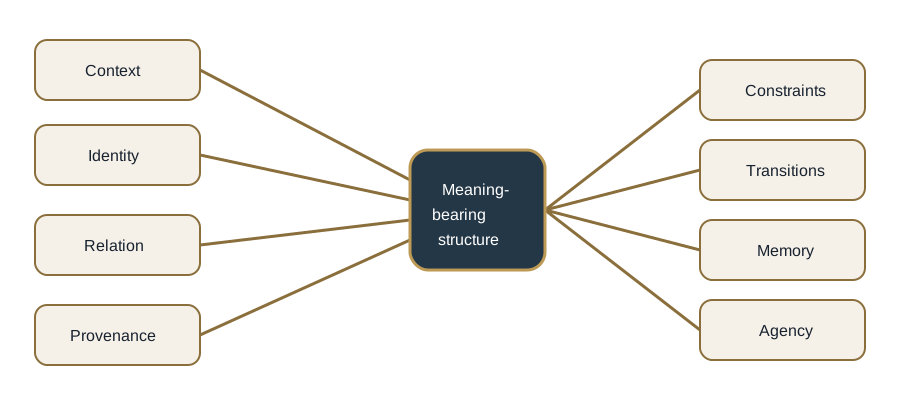
The figure is an orientation, not an implementation diagram. It shows that a meaning-bearing structure is shaped by context, identity, relation, and provenance before it can responsibly support later work.
The problem CDS addresses#
Information can be available and still be unusable. A note may have no source. A summary may omit the qualification that made a claim responsible. A record may move into a new setting and keep an authority it no longer has. When those relationships disappear, the system has fragments rather than understanding.
CDS preserves enough structure to keep the important relationships available. It helps a reader ask: what is this about; where did it come from; what does it connect to; and what would make this reuse misleading?
A simple example#
“Stabilize before scaling” can be a useful recommendation. But its meaning depends on the system being discussed, the evidence of instability, the risks of scaling, and the person responsible for the decision. A CDS-oriented representation keeps those relations close to the recommendation. It does not turn the sentence into a technical object; it prevents the sentence from becoming a context-free slogan.
Where CDS sits in Supporting Structures#
CDS is the first entry in the Supporting Structures reader path because the later concerns need something meaningful to work with. Constraints protect valid bounds. Transitions make change legible. Memory preserves continuity across time. Agency clarifies who may act and who remains responsible.
CDS does not replace any of them. It gives the rest of the path a meaning-bearing starting point.
What CDS is not#
- It is not generic JSON, an embedding, or a conventional database record.
- It is not a promise that all knowledge can be fully formalized.
- It is not an operational data model or a product specification.
- It is not a substitute for human interpretation and judgment.
Forthcoming book relationship#
This primer introduces the public question behind Cognitive Data Structures. A forthcoming book, when separately released, will provide its own sustained treatment. This page remains a durable orientation for readers who want to understand why meaning-preserving structure matters before going deeper.