
Visual Guide
The Mandala Protocol Visual Guide
A guided view of the five-layer architecture behind structured meaning, learning, transformation, and governed intelligence.
This guide selects nine figures from The Mandala Protocol to explain the book's central architecture. It is a reading aid for the publication, not a complete figure archive or a tool surface.
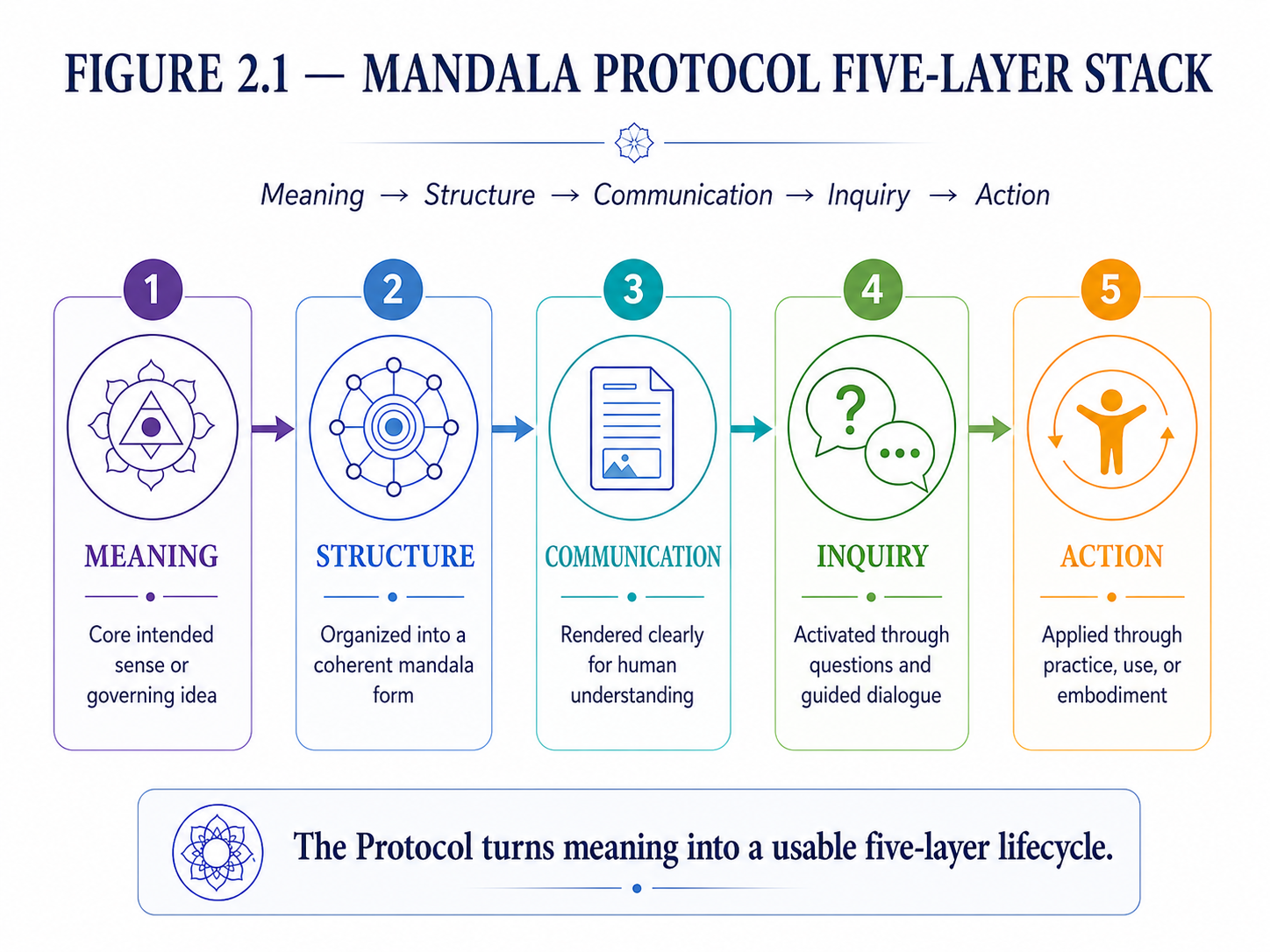
01 / FIGURE 2.1 - Mandala Protocol Five-Layer Stack
The Five-Layer Stack
The five-layer stack shows the protocol as an ordered architecture rather than a loose collection of ideas. Each layer has a distinct responsibility: preserving a center, forming meaningful structure, arranging that structure into a map, rendering it for human use, and governing its validity. The value of the stack is not complexity for its own sake. It gives readers a way to see how meaning can remain stable while moving from seed form to communication, learning, transformation, and accountable use.
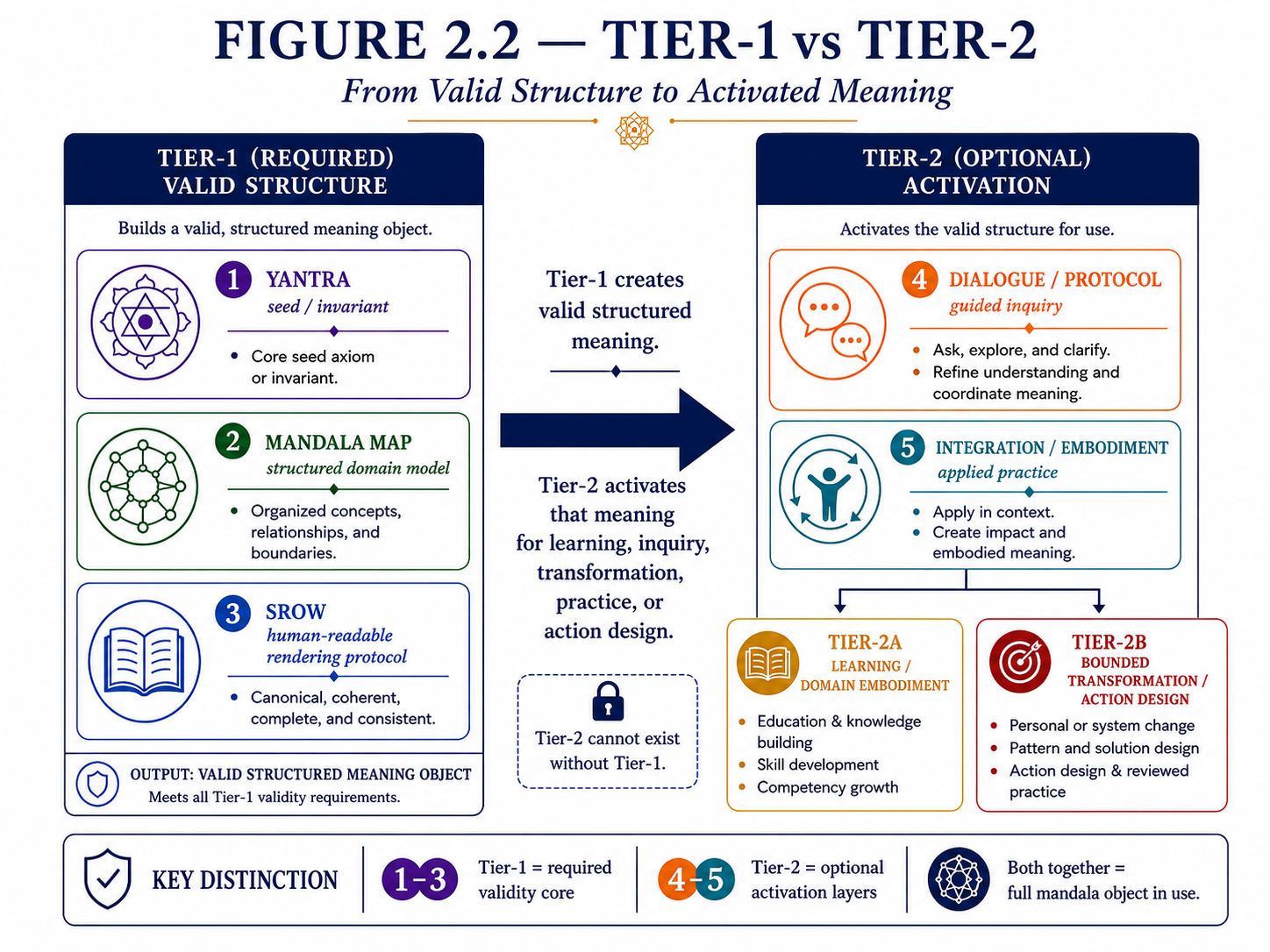
02 / FIGURE 2.2 - Tier-1 vs Tier-2
Required Structure and Optional Activation
The distinction between Tier-1 and Tier-2 keeps the protocol from confusing required structure with optional activation. Tier-1 names what must be present for a mandala object to remain coherent: center, boundary, layers, relationships, rendering, and validation. Tier-2 describes what may happen after that structure is stable, including learning loops, transformation paths, or applied uses. This separation protects the publication from becoming an operations manual. It clarifies what the architecture requires before any downstream system attempts to act on it.
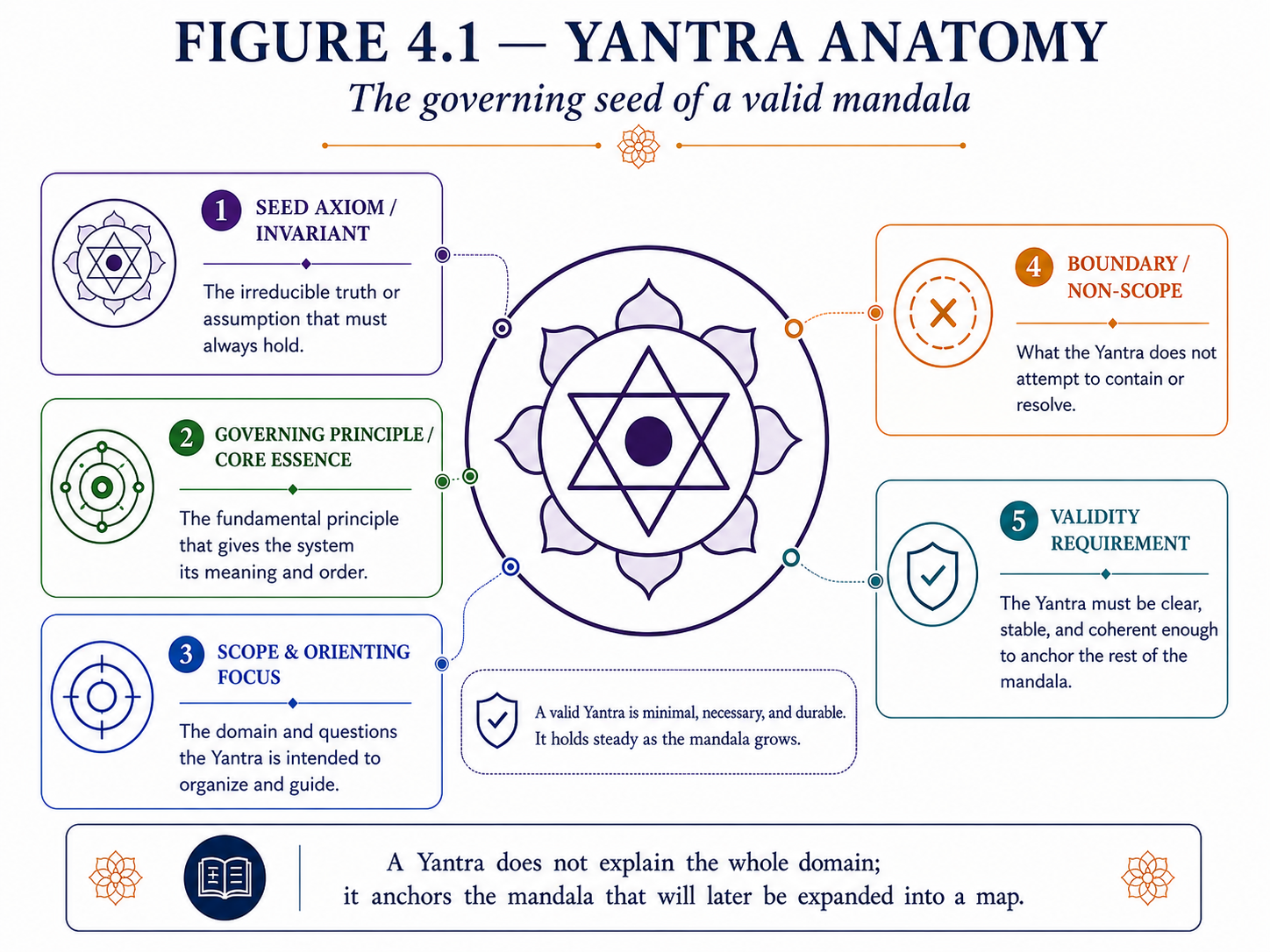
03 / FIGURE 4.1 - Yantra Anatomy
The Seed: Yantra
The yantra is the seed form of the protocol. It names the central object before expansion, so the mandala does not begin as an undifferentiated map. A valid seed carries identity, purpose, boundaries, and basic relational orientation. This matters because later layers depend on the quality of the initial center. If the seed is vague, every later map can look organized while still drifting conceptually. The yantra gives the architecture a disciplined starting point before explanation, interpretation, or application begins.
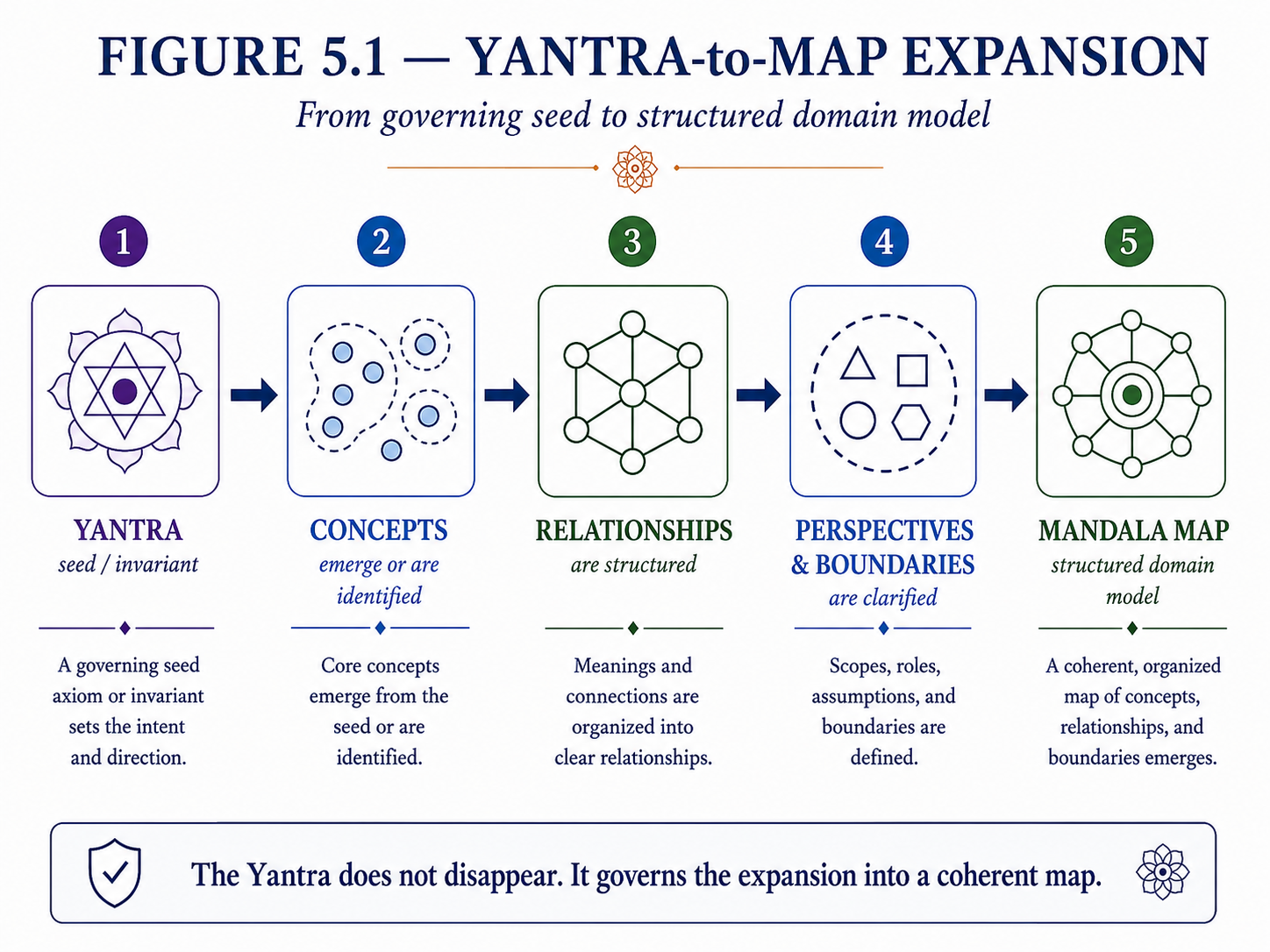
04 / FIGURE 5.1 - Yantra-to-Map Expansion
From Yantra to Map
Expansion from yantra to map is the movement from compact identity into organized relation. The protocol does not treat this as simple decoration around a center. It asks how the center generates surrounding categories, dependencies, boundaries, and interpretive paths without losing itself. This is where a mandala becomes useful for structured understanding. The map can hold more material than the seed, but its legitimacy still depends on whether each expansion remains accountable to the original center and to the constraints that make the object intelligible.
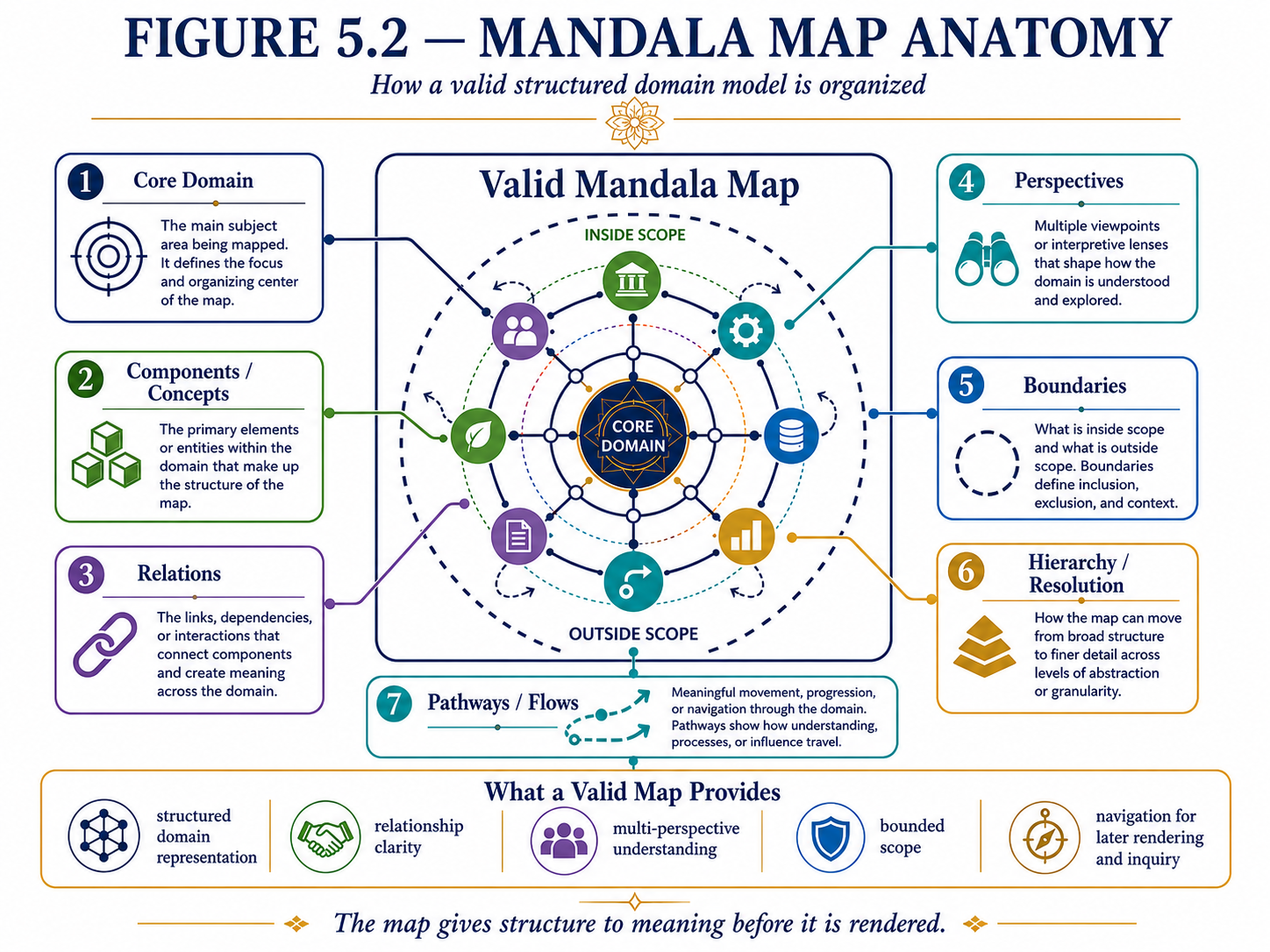
05 / FIGURE 5.2 - Mandala Map Anatomy
The Mandala Map
The mandala map shows how the expanded object is arranged for inspection. It is not only a visual composition; it is a structural claim about how parts relate to the whole. Rings, segments, paths, and boundaries help readers see which elements are central, which are supporting, and which depend on other layers for interpretation. This makes the map useful for human reading and machine-facing organization. The visual form helps preserve proportion, sequence, and relation without replacing the need for careful explanation.
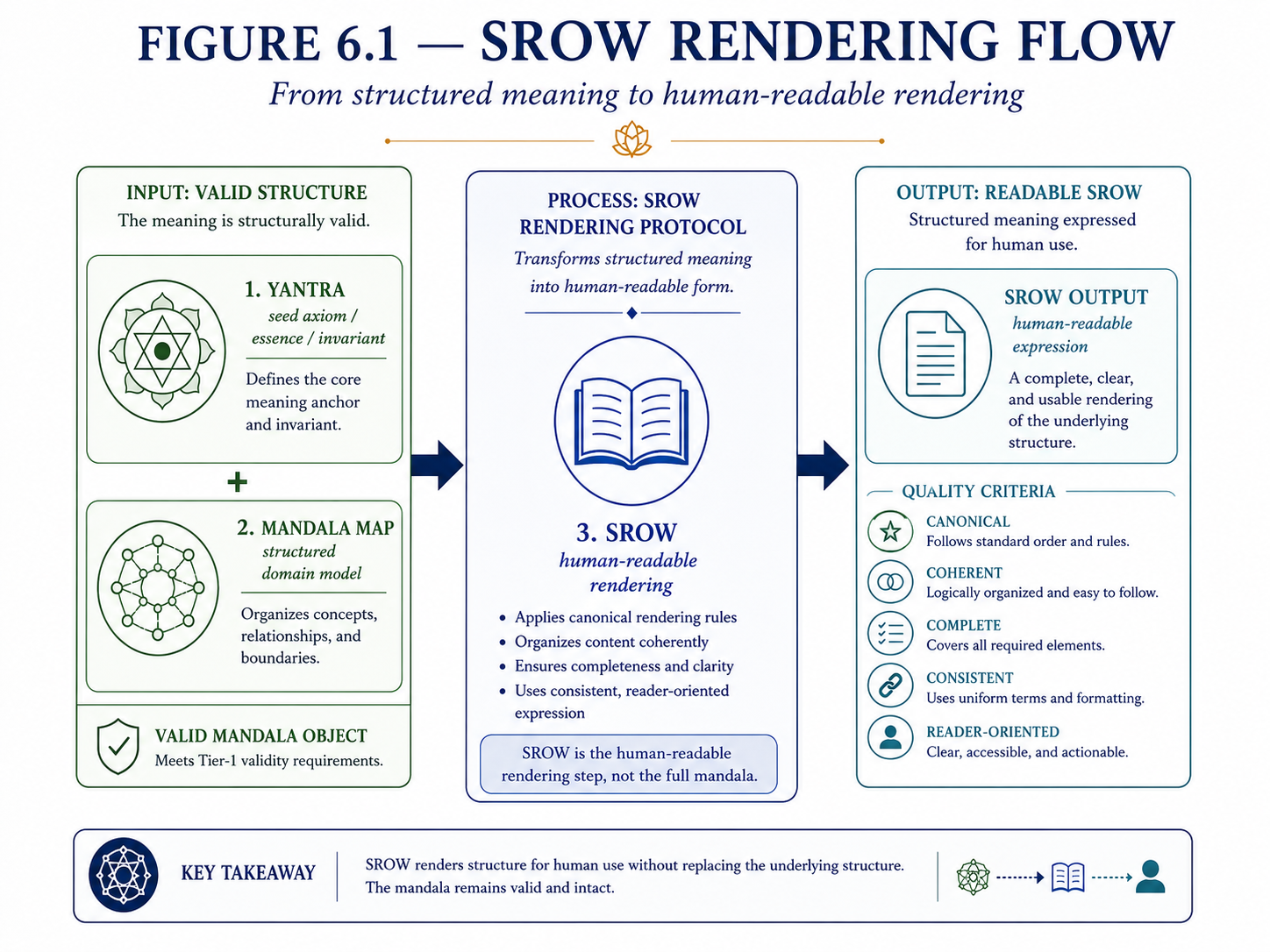
06 / FIGURE 6.1 - SROW Rendering Flow
Rendering Meaning for Human Use
SROW rendering explains how structured meaning becomes readable without flattening the architecture behind it. The protocol recognizes that a valid map still needs a disciplined communication layer. Rendering decides what enters first, how sections relate, where depth belongs, and how a reader can move through the object without losing orientation. This is why the publication treats writing and display as architectural concerns, not afterthoughts. Human use requires clarity, but clarity should reveal structure rather than erase the relationships that make the mandala meaningful.
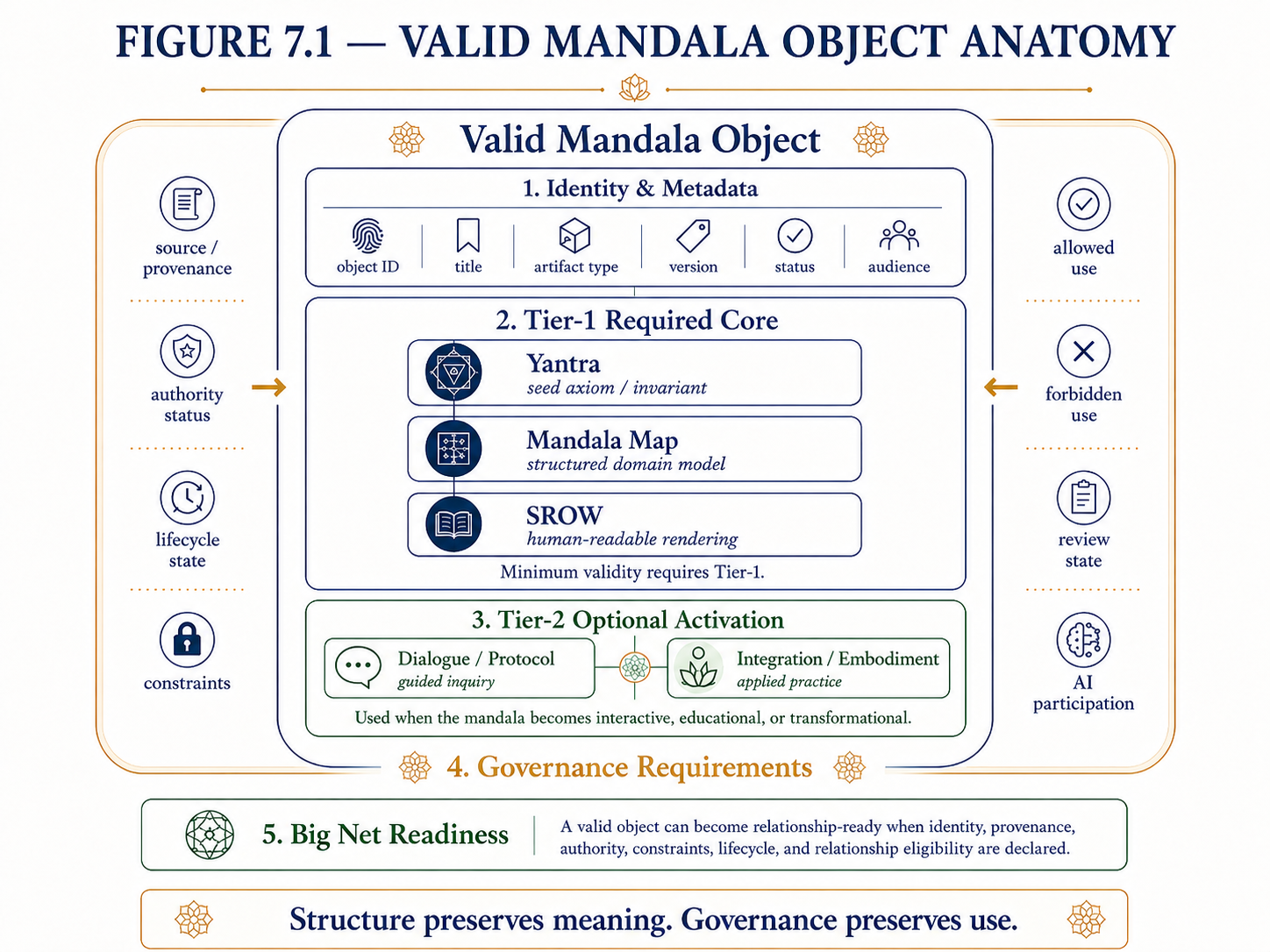
07 / FIGURE 7.1 - Valid Mandala Object Anatomy
What Makes a Mandala Object Valid
A valid mandala object is not defined by visual symmetry alone. It needs a named center, explicit boundaries, coherent layers, traceable relationships, readable rendering, and a way to test whether additions still belong. This figure brings those requirements together as an object-level anatomy. The point is governance, not ornament. A mandala can grow, translate, or be reused only if its structure remains inspectable. Validity gives the architecture a basis for disciplined extension instead of treating any complex diagram as a mandala.
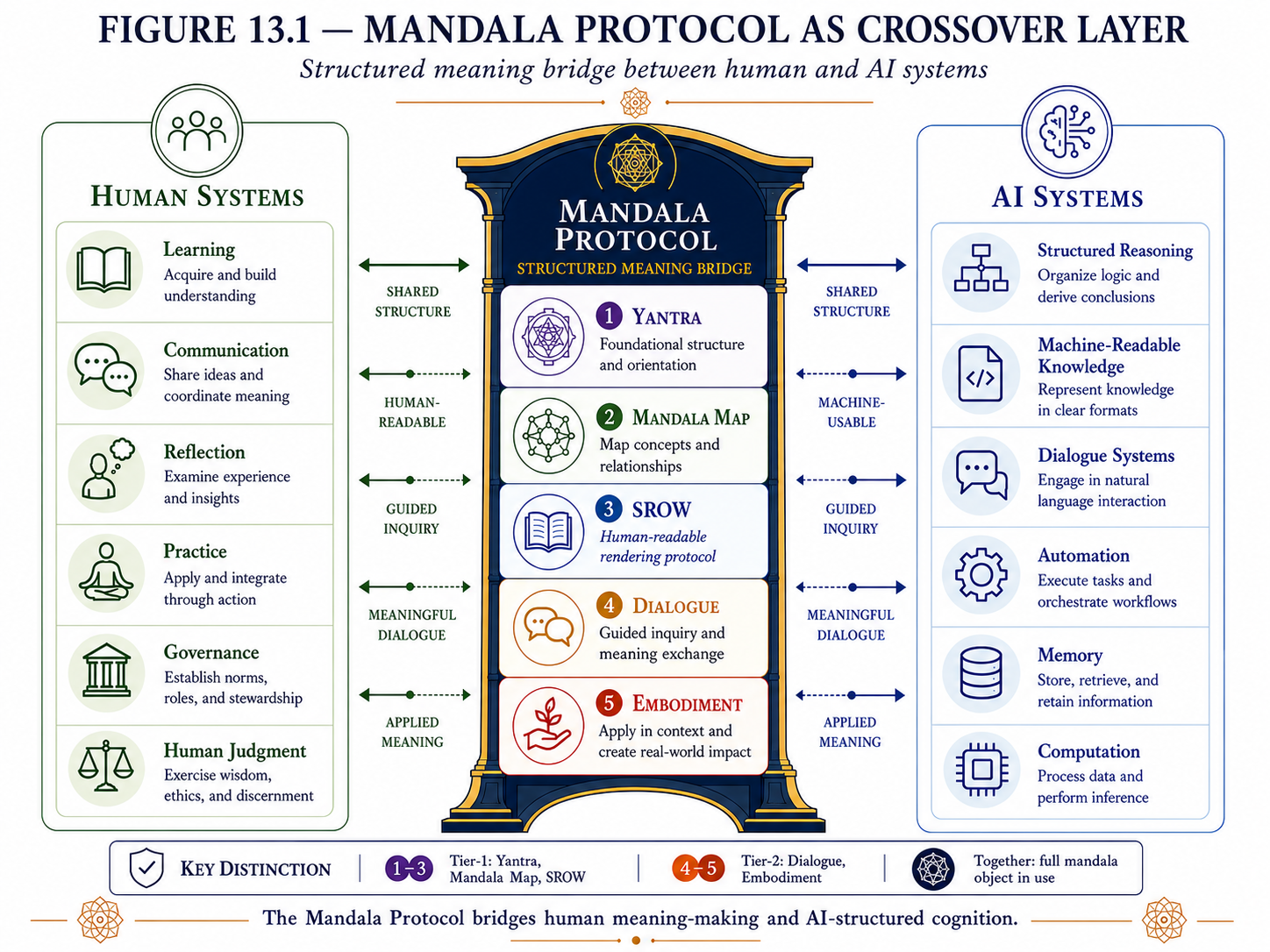
08 / FIGURE 13.1 - Mandala Protocol as Crossover Layer
The Human-AI Crossover Layer
The crossover layer shows why The Mandala Protocol belongs between human interpretation and machine-facing structure. Human readers need meaning, orientation, and judgment. AI-facing systems need explicit boundaries, relationships, and validation surfaces. The protocol gives both sides a shared structural object without pretending that one side replaces the other. This is the canonical role of the crossover layer: it helps meaning travel between explanation and computation while keeping the publication centered on architecture rather than operational workflow or platform implementation.
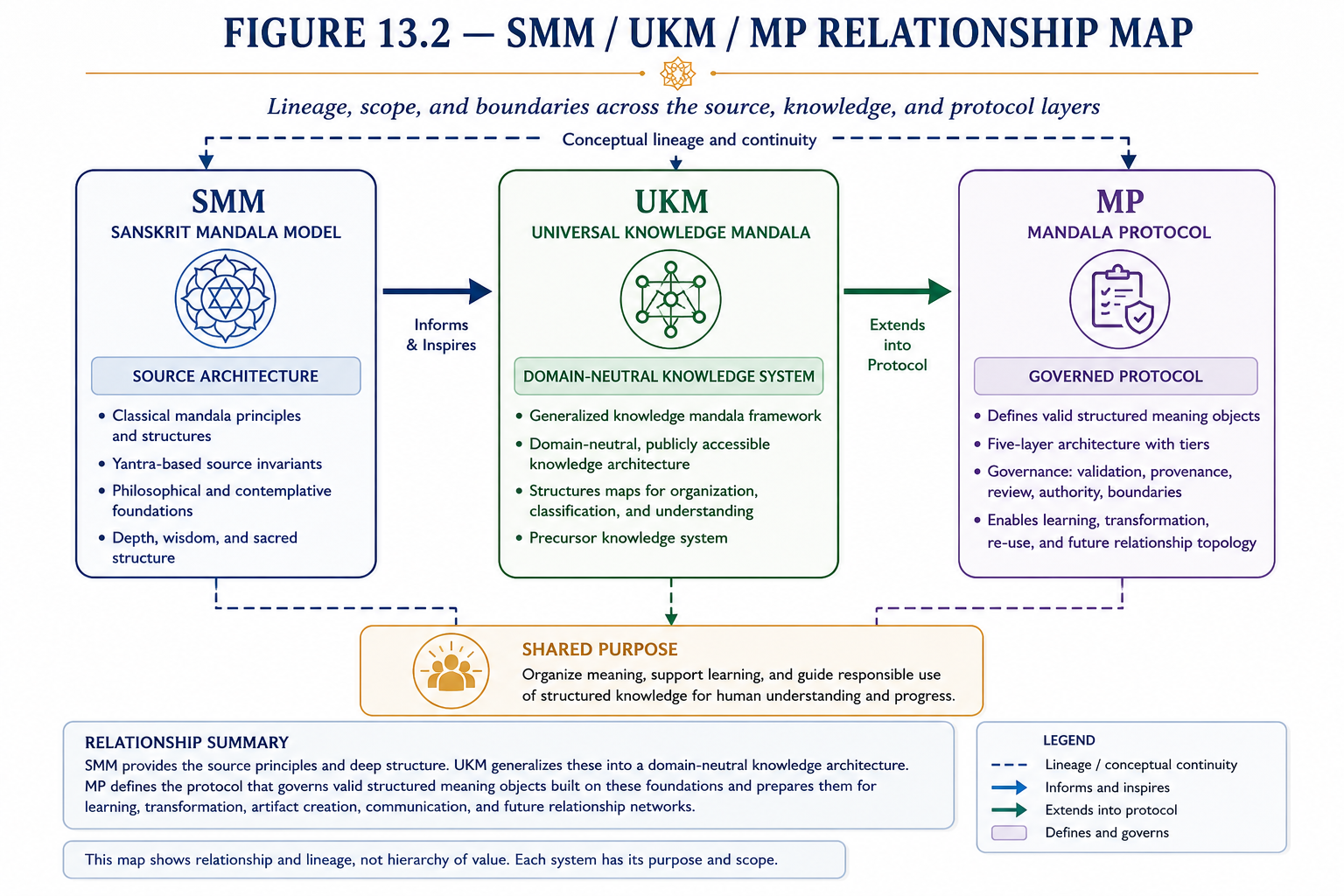
09 / FIGURE 13.2 - SMM / UKM / MP Relationship Map
The Series Context
The relationship map places The Mandala Protocol inside Foundations of Mandala Intelligence. The Sanskrit Mandala Model gives the series its layered intelligence frame. Universal Knowledge Mandala generalizes structured knowledge across domains. The Mandala Protocol names the pattern by which mandalas are formed, rendered, validated, and extended. The page keeps these roles distinct so the series reads as a coherent publication line rather than a bundle of interchangeable labels. Each book contributes a different part of the same architectural vocabulary.
Continue from the guide
The guide returns readers to the canonical publication record, the series surface, or the Amazon listing without creating a separate tool path.