
Lynn Walker · WinMedia
This is a constructed teaching case. The proposal records and AI output below are invented so that you can inspect every relevant calculation. It is not an account of an actual client incident or a recorded model test.
You are preparing a comparison of two service proposals for a client. AI has helped summarize the charges and draft a recommendation. The result looks ready for review, until you notice that one setup fee has been treated as a monthly charge.
You correct the AI summary. The new total is right. But the earlier number has already entered a spreadsheet, a presentation slide, and a draft email. None has been sent. A correction in the chat has changed only one of the places where the mistake now lives.
The records you can inspect#
The fictional proposal records state:
- Proposal A: $240 per month, plus a $180 one-time setup charge.
- Proposal B: $270 per month, with no setup charge.
- Comparison period: 12 months.
Taxes, usage charges, and later renewal terms are not supplied. The task is to compare the stated charges over those 12 months. Choosing a supplier also requires other considerations that this calculation does not settle.
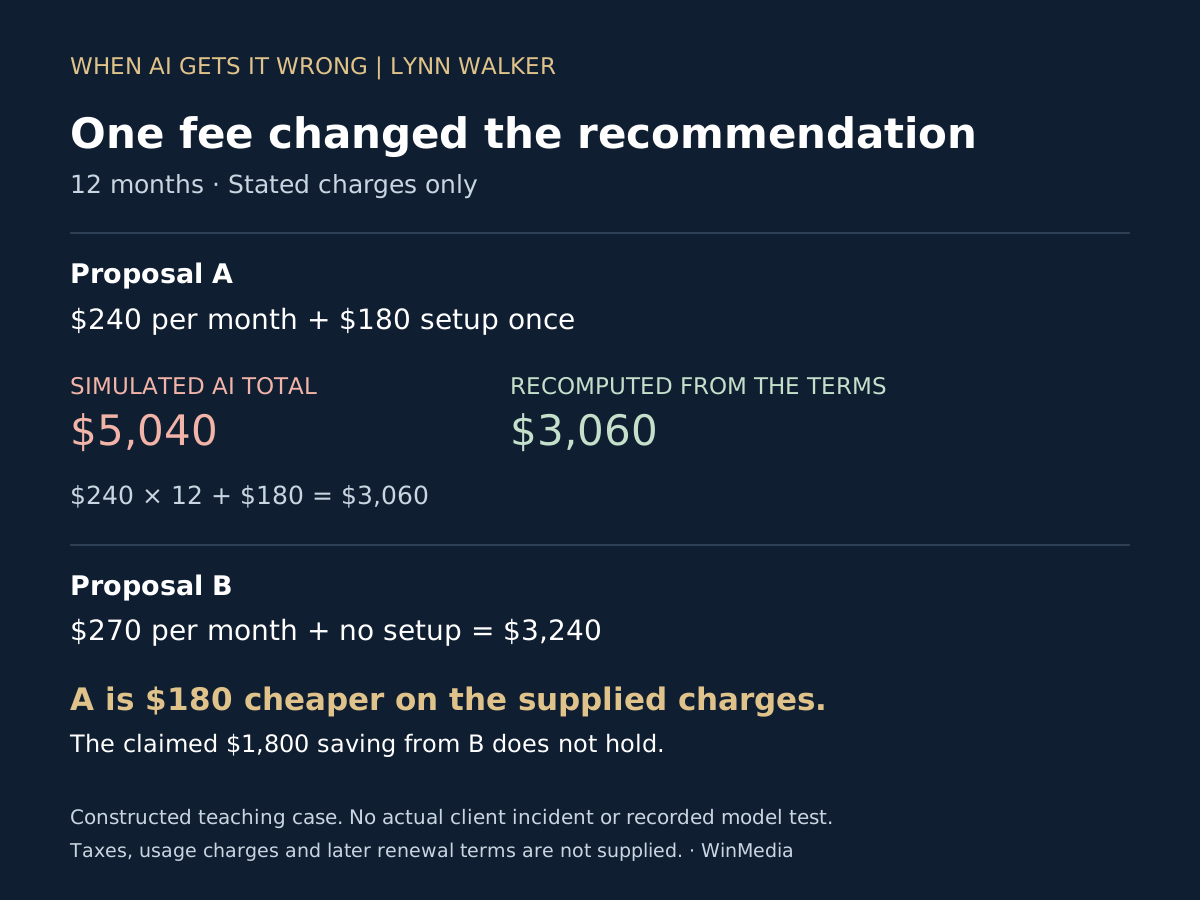
Simulated AI summary: Proposal A costs $5,040 over 12 months. Proposal B costs $3,240, saving $1,800.
That first total comes from multiplying both A's monthly charge and its one-time setup charge by 12: ($240 + $180) × 12. The calculation follows the wrong interpretation of the fee.
Preserve the version and pause the affected use#
Save the original summary and identify the three known drafts that copied its figures. Keep the cost recommendation from being sent while you check it. A brief note attached to the drafts can record the hold and the versions being checked.
Name the issue precisely: A's setup charge was applied 12 times instead of once. That is a supported finding from the supplied record. Whether every other part of the proposals is accurate remains a separate question.
Recompute from the stated terms#
For Proposal A, the monthly charges are $240 × 12 = $2,880. Add setup once: $2,880 + $180 = $3,060.
For Proposal B, $270 × 12 = $3,240.
On these stated charges, A is $180 cheaper over 12 months. B does not provide the claimed $1,800 saving. A second way to inspect the difference is to calculate B's extra $30 per month: $30 × 12 = $360. A's $180 setup charge reduces that difference to $180.
Both routes use the same fictional inputs. They help check the arithmetic; they cannot establish that an actual supplier's quotation is current or complete.
Trace what depends on the mistake#
The spreadsheet contains the $5,040 total. The slide repeats the $1,800 saving and recommends B on cost. The draft email carries that recommendation forward.
These are three known uses, with two kinds of damage: a wrong amount and conclusions drawn from it. Search the relevant working files for the amounts and recommendation, and record the scope you inspected. A search of one folder does not establish the absence of copies elsewhere.
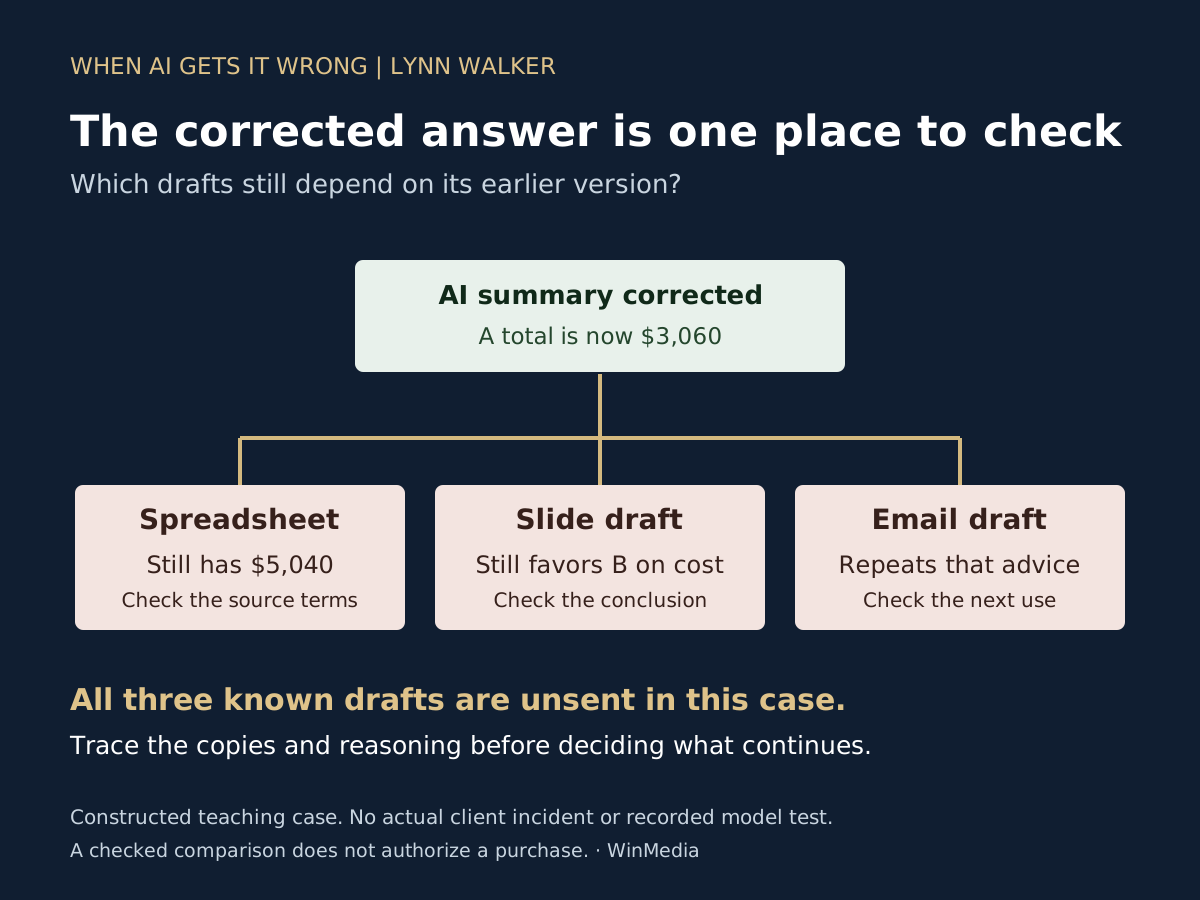
If another person holds a copy you cannot inspect, leave that item open and ask its owner to check. In this constructed case, all three known drafts are accessible and unsent.
Repair the amounts and the reasoning#
Correct A's total in the spreadsheet and check the comparison formula. Replace the slide's saving claim with the supported $180 difference. Revise the email so it no longer recommends B because of the nonexistent saving.
Preserve independently checked material, such as a correctly copied service description. Its survival needs a reason: it was compared with the relevant source and does not depend on the faulty calculation. Restoring an entire older draft could bring back other outdated content.
The repaired comparison should retain its limit: these are the supplied charges for 12 months. It should not turn the lower stated total into an unconditional supplier recommendation.
Check each version before deciding what continues#
Read the spreadsheet, slide, and email against the source record. Confirm both the figures and the conclusion each document now expresses. Record which versions you checked.
The consultant can then put the corrected cost comparison forward for client review, within the agreed task. That does not authorize a purchase, establish the missing charges, or give AI permission to make commitments.
If the mistake had already reached someone else, editing local files would leave an additional task: getting a clear correction to the known recipients and checking what they had already relied on.
Use the case on your own work#
The useful question after “Is this correction right?” is “Which work still depends on the earlier version?” The answer sets the scope of the repair.
Download the free worksheet to record the finding, affected work, checks, and next decision. No email address is required.
For the fuller response, read When AI Gets It Wrong: Containing Mistakes, Repairing the Work, and Deciding When to Continue, by Lynn Walker.