
Central control is not the only way to keep a system whole#
Many systems are designed under an implicit fear: if there is no single controlling center, coherence will collapse. Under that assumption, distributed systems are tolerated only as weaker copies of centralized ones. They may scale, but they are expected to fragment. They may spread, but they are assumed to lose meaning.
That assumption confuses coherence with command. A system does not remain whole merely because one place dominates every other place. It remains whole because relation, transition, and responsibility remain intelligible across the distributed field.
This is a difficult distinction because centralization often provides visible order. It concentrates decision, simplifies arbitration, and creates a recognizable source of authority. But visible order is not identical to durable coherence. A centralized structure can be brittle, opaque, and overdependent on a single interpretive bottleneck. A distributed structure can remain coherent if it preserves the relations that let the whole continue to make sense.
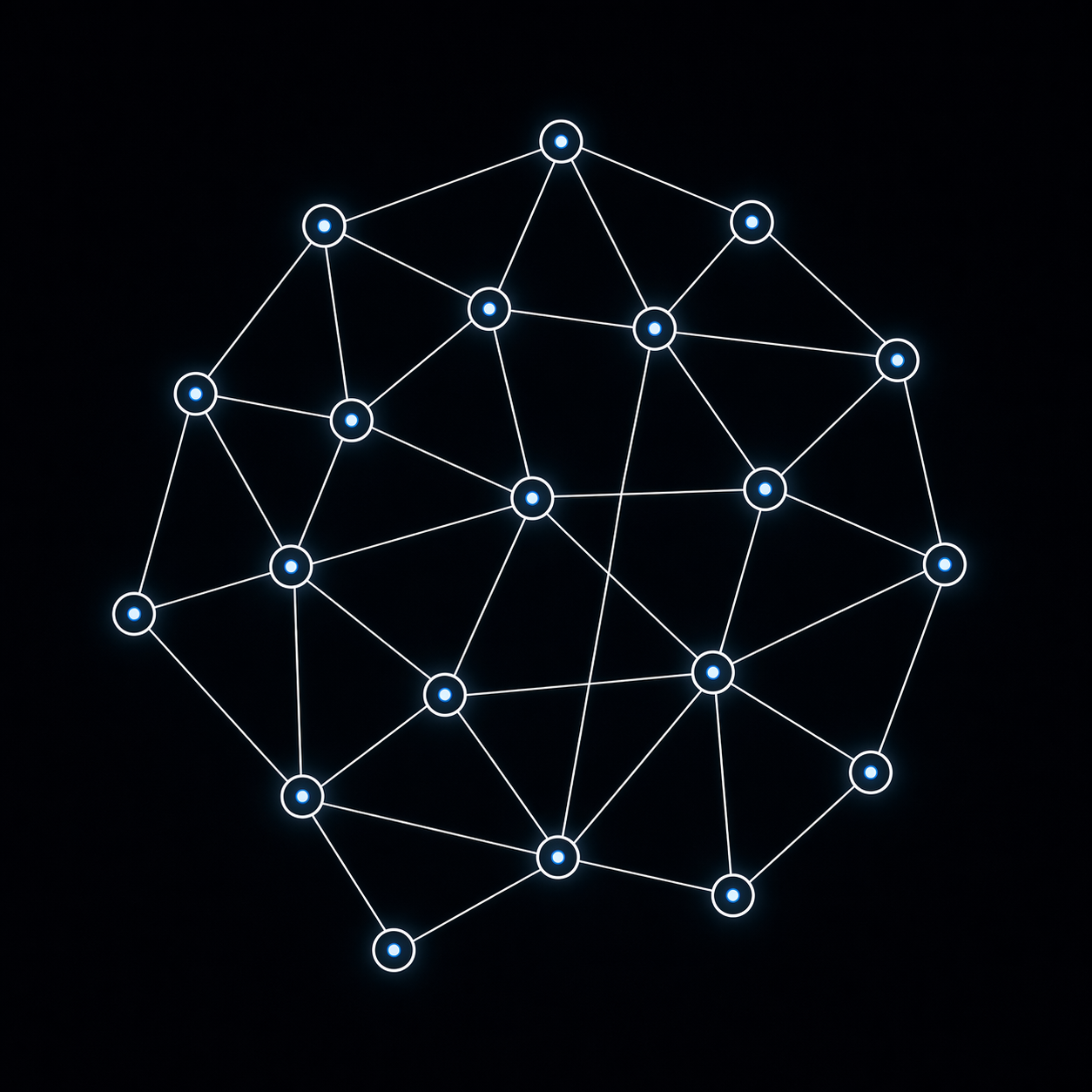
Coherence is not uniformity#
One reason centralization is overvalued is that coherence is often imagined as sameness. If every node says the same thing, uses the same terminology, or reports to the same source, the system is presumed coherent. But uniformity is a poor proxy.
Uniform systems can conceal deep misunderstanding. They can produce aligned surfaces while suppressing local distinctions, contextual nuance, and structural variation. What looks stable may be only the appearance of consistency produced by compression.
Real coherence is more demanding. It has to survive difference. It has to let distinct nodes hold distinct roles without losing the relations that tie them together. It has to preserve meaning across distance, not by eliminating variation, but by organizing it.
That is why distributed intelligence should not be judged by how little variation it allows. It should be judged by whether variation remains intelligible within the whole.
Fragmentation is not the same as distribution#
The opposite error is to romanticize distribution itself. A system with many nodes, many voices, or many surfaces is not automatically distributed intelligence. It may simply be fragmentation with a richer vocabulary.
Fragmentation occurs when nodes no longer preserve meaningful relation. They continue acting, but the system loses a shared basis for interpretation. Transitions between parts become weak or opaque.
Shared memory degrades. Concepts begin to drift apart under local pressures. What remains is a collection, not a coherent net.
A distributed system therefore needs stronger discipline than is often acknowledged. It requires role clarity, durable relational structure, and transitions that can be followed rather than guessed. Without those conditions, decentralization becomes dispersion.
The system level is preserved through relation#
The central question is not whether there is one center or many. The question is whether the system preserves a legible whole-form across its distributed activity.
That whole-form is maintained relationally. Nodes do not need to collapse into sameness, but they must remain accountable to each other through structures that preserve meaning. Relations have to carry more than connection. They have to carry orientation, dependency, and interpretive consequence.
This is one of the reasons coherence is harder than connectivity. Connectivity can be added quickly. Coherence requires a deeper architecture. It depends on what each node is responsible for, how transitions are preserved, and how differences remain comprehensible inside the whole.
Framework connections#
Big Net is directly relevant because it treats distributed cognition as an architectural question rather than as a networking metaphor. The issue is not merely linking nodes. It is preserving meaning across distributed positions without reducing the system to a single commanding viewpoint.
MoM matters because distributed coherence depends on transition legibility. If movement between nodes, interpretations, or states cannot be followed, then the system cannot tell whether distribution is still producing a coherent whole or only multiplying local outputs.
Supporting Structures matters because distribution relies on memory, constraints, boundaries, and other stabilizing conditions beneath visible coordination. When those supporting structures are weak, no amount of nominal networking will preserve coherence.
Why centralization often disguises a deeper weakness#
Centralization looks efficient because it keeps interpretive authority concentrated. But that concentration can hide a deeper weakness: the system may never learn how to preserve coherence except by routing everything through one point.
Such systems often fail abruptly when the center is overloaded, absent, or wrong. They have not developed distributed intelligibility. They have only developed dependence.
By contrast, a coherent distributed system does harder work upfront. It invests in relation, memory, and transition discipline. It makes nodes more locally meaningful while keeping them more globally accountable. This is not a rejection of structure. It is structure expressed across the field rather than monopolized at the top.
What changes when this is understood#
Once coherence is separated from centralization, the design question changes. We stop asking only where control should sit. We ask what allows meaning to remain whole across distributed responsibility.
That shift matters for knowledge systems, institutions, writing, and cognitive architectures alike. It exposes why many apparently decentralized systems are actually fragmented, and why some apparently centralized systems are only coherent so long as their bottleneck remains intact.
The stronger alternative is neither command nor drift. It is relation strong enough to preserve intelligibility without demanding uniformity. A system built on that basis can distribute responsibility widely while still remaining recognizably whole.