Mandala Notes — Designing Knowledge That Can Be Understood, Not Just Computed
Modern knowledge systems—whether educational curricula, organizational processes, or artificial intelligence—often fail in the same way: they scale information, but not understanding.
As complexity grows, meaning fragments. Decisions become harder to justify. Outputs become harder to trust.
The Sanskrit Mandala Model (SMM) was developed to address this exact failure mode—not by adding more data or bigger models, but by restoring structure to how knowledge itself is organized, expanded, and applied.
Signal Layer — Quick Orientation
- SMM is a mandala-based architecture for structuring knowledge and intelligence.
- It combines an invariant core (yantra) with layered expansion (mandala).
- It scales meaning without losing coherence or accountability.
- It bridges spiritual insight and technical system design.
Language, structure, and the limits of flat intelligence
Most contemporary systems—human and artificial—operate on what can be called flat intelligence: inputs go in, outputs come out, and the internal structure remains largely implicit.
This works surprisingly well for pattern recognition, but poorly for:
- Long-term reasoning
- Explainability
- Ethical alignment
- Iterative refinement without drift
When everything is treated as undifferentiated text or data, systems grow powerful but opaque. They become difficult to audit, teach, or responsibly evolve.
The Sanskrit Mandala Model: structure before scale
The Sanskrit Mandala Model takes inspiration from Sanskrit not as a religious artifact, but as a historically refined system for preserving meaning across layers of transformation.
At its core, SMM asserts a simple principle:
Understanding scales only when structure scales first.
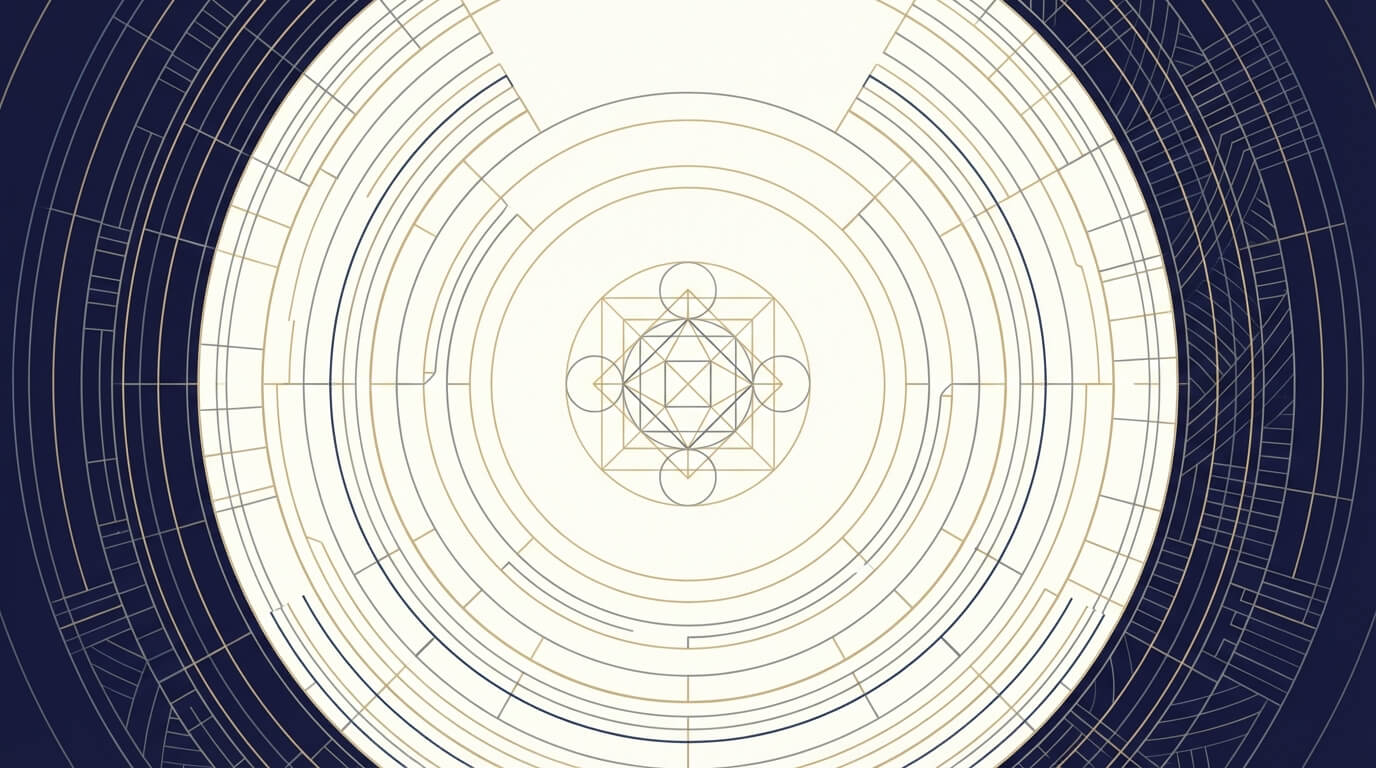
SMM organizes knowledge into a mandala: a layered system that grows outward from a stable center while maintaining internal coherence.
Scan Layer — What defines SMM
- A fixed yantra (invariant structural core)
- Layered mandala expansion (rings of meaning)
- Explicit constraints to prevent drift
- Clear pathways from insight to practice
How SMM works: yantra and mandala
The model is composed of two complementary elements.
The Yantra: invariant structure
The yantra represents what must not change: the organizing geometry of the system.
In practical terms, the yantra defines:
- What kinds of layers exist
- How information may flow between them
- What constraints preserve meaning integrity
This is what prevents arbitrary expansion. Without a yantra, growth becomes noise.
The Mandala: layered expression
The mandala is the lived, applied structure. It is where context, examples, workflows, and practices appear.
Each ring adds specificity without breaking alignment with the core. This allows:
- Local adaptation
- Iterative refinement
- Multiple valid perspectives within one system
Why this matters for AI and human systems
SMM is not an abstraction for its own sake. It directly addresses weaknesses in modern AI and organizational design.
Scan Layer — Practical impact
- Makes reasoning inspectable
- Supports explainability by design
- Enables safe iteration without semantic drift
- Aligns outputs with declared values and constraints
Rather than relying on ever-larger models or increasingly clever prompts, SMM emphasizes structural clarity.
In AI systems, this means the difference between:
“A system that answers” vs. “a system that understands why it answered.”
From theory to application: the MandalaStacks framework
SMM does not exist in isolation. It operates within a larger ecosystem of mandala-based systems.
At the meta level, it is governed by the MandalaStacks framework , which defines how different mandala models relate and evolve.
At the applied level, SMM principles are made tangible through MandalaStacks interactive generators that turn abstract structure into actionable artifacts.
What these generators demonstrate
- How layered knowledge can be generated consistently
- How constraints improve clarity instead of limiting creativity
- How insight becomes something you can work with, not just admire
The deeper shift
The Sanskrit Mandala Model represents a shift away from brute-force intelligence and toward intelligible intelligence.
It asks a different design question:
“How do we build systems that can grow without losing their soul?”
Whether applied to learning, leadership, software architecture, or AI reasoning, SMM offers a path forward: structure first, expansion second, action always grounded in meaning.
This is not about returning to the past. It is about recovering design principles we still need—and now need more than ever.
Where to explore next
- Explore the full structural context in the Mandala of Mandalas framework
- See SMM applied through interactive Mandala generators
- Experiment directly with the Domain Mandala Generator